
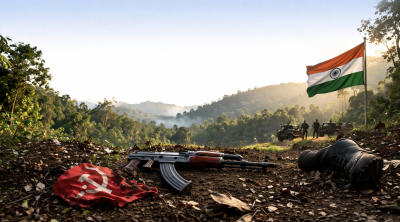
The Union Home Minister announced on March 30, 2026, that Naxalism has been largely eliminated from Bastar and India. The government set a unique deadline in August 2024 to end the Maoist insurgency by March 31, 2026. This deadline pushed security forces to intensify their operations. The success is attributed to combined efforts in security and regional development.
Security Operations and Forces Involved
The Central Reserve Police Force (CRPF) was the lead agency in countering Maoist insurgents. Other Central Armed Police Forces (CAPF) such as the Border Security Force (BSF), Central Industrial Security Force (CISF), Indo-Tibetan Border Police (ITBP), and Sashastra Seema Bal (SSB) also played key roles. The Commando Battalion for Resolute Action (CoBRA) conducted critical operations, including a major 21-day mission in the Karregutta hills that killed over 31 Maoists. The elimination and surrender of many top leaders weakened the Maoist network .
Infrastructure and Development Initiatives
Road connectivity in the Maoist stronghold of Abujhmarh was a major challenge. The Border Roads Organisation, supported by the CRPF, began road construction under heavy security. This opened access to over 12,000 km of roads, allowing development to reach isolated villages. More than 5,000 mobile towers were installed, and villagers received thousands of mobile phones, improving communication and intelligence gathering. Forward operating bases set up in the region helped maintain law and order.
Impact on Maoist Leadership and Local Population
Several key Maoist leaders were killed in encounters, while others surrendered due to pressure and attractive rehabilitation schemes. The remaining leaders, including Mupalla Lakshmana Rao and Misir Besra, have yet to surrender. Their eventual surrender is expected to mark the complete end of Naxalism. The combined use of human and technical intelligence cut Maoist links with villagers and reduced their influence.
Significance of the Naxalism Decline
This achievement is historic as no previous government set such a deadline to end an insurgency. The integrated approach of security and development serves as a model for handling internal conflicts. The restoration of peace in Maoist-affected states is expected to boost socio-economic growth and improve governance in these regions.
Topics for Prelims:
Central Reserve Police Force (CRPF)
- Primary internal security force of India since 2001.
- Leads anti-Maoist operations in affected states.
- Operates Commando Battalion for Resolute Action (CoBRA).
- Supports road construction and infrastructure projects.
- Maintains forward operating bases in conflict zones.
Maoist Insurgency (Naxalism)
- Left-wing extremist movement in India.
- Stronghold in Bastar and Abujhmarh regions.
- Uses guerrilla warfare and controls remote areas.
- Leadership weakened by encounters and surrenders.
- Opposed by security forces and development initiatives.
Abujhmarh Region
- Maoist stronghold in Chhattisgarh.
- Previously inaccessible due to dense forests.
- Roads constructed under CRPF and BRO protection.
- Mobile connectivity expanded with 5,000 towers.
- Site of major security operations against Maoists.
Questions for Mains:
- Critically discuss the role of integrated security and development strategies in countering insurgencies in India. [GS-III-Internal & External Security]
- Examine the challenges faced by security forces in Maoist-affected regions and analyse the measures taken to overcome them. [GS-III-Internal & External Security]
- Estimate the impact of improved infrastructure and communication on socio-economic development in conflict zones, and point out its effects on local insurgencies. [GS-III-Economic Development]
- Analyse the significance of leadership decapitation in insurgent movements and discuss the role of rehabilitation schemes in conflict resolution. [GS-II-Governance]
Answer Hints:
1. Critically discuss the role of integrated security and development strategies in countering insurgencies in India. [GS-III-Internal & External Security]
- Integrated approach combines robust security operations with simultaneous socio-economic development.
- Security forces (CRPF, CoBRA, CAPFs) focus on intelligence-driven operations to dismantle insurgent networks.
- Development initiatives (road construction, mobile connectivity) break isolation of conflict areas, reducing insurgent influence.
- Improved infrastructure facilitates faster troop movement and better governance reach.
- Development addresses root causes like poverty and alienation, complementing security efforts.
- Model demonstrated in Bastar and Abujhmarh shows effectiveness in ending Maoist insurgency by 2026.
2. Examine the challenges faced by security forces in Maoist-affected regions and analyse the measures taken to overcome them. [GS-III-Internal & External Security]
- Geographical challenges – dense forests, difficult terrain, and inaccessible areas like Abujhmarh.
- Hostile local population influenced by Maoists, limiting intelligence flow.
- Frequent ambushes and attacks on security personnel and infrastructure projects.
- Measures – deployment of specialized forces like CoBRA and CRPF, establishment of forward operating bases.
- Secured road construction by Border Roads Organisation under CRPF protection to improve mobility.
- Use of human and technical intelligence to isolate insurgents from villagers and disrupt their networks.
3. Estimate the impact of improved infrastructure and communication on socio-economic development in conflict zones, and point out its effects on local insurgencies. [GS-III-Economic Development]
- Road connectivity (12,000 km built) opened isolated villages to markets, healthcare, and education.
- Installation of 5,000+ mobile towers and distribution of mobile phones enhanced communication and access to information.
- Improved infrastructure facilitated government schemes and economic activities, reducing poverty and alienation.
- Connectivity allowed security forces rapid deployment, improving law and order.
- Better communication severed insurgents’ control over local populations and intelligence sources.
- Overall, socio-economic upliftment weakened insurgency support base and encouraged mainstreaming.
4. Analyse the significance of leadership decapitation in insurgent movements and discuss the role of rehabilitation schemes in conflict resolution. [GS-II-Governance]
- Elimination/surrender of key Maoist leaders (e.g., Madvi Hidma, Basavaraju) caused organizational disarray and morale decline.
- Leadership vacuum disrupts command, control, and operational capabilities of insurgents.
- Rehabilitation schemes provide incentives for surrender, offering livelihood, education, and social integration.
- Such schemes reduce recidivism and encourage former insurgents to join mainstream society.
- Combined with security pressure, leadership decapitation and rehabilitation accelerate conflict resolution.
- Pending surrender of remaining leaders (Ganapathy, Sagar) marks last phase of insurgency endgame.