
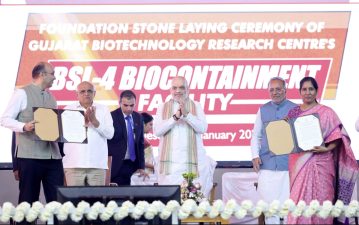
India has begun work on a state-of-the-art BSL-4 Bio-Containment Facility at the Gujarat Biotechnology Research Centre in Gandhinagar. The project is a major step in strengthening the country’s health security, bio-safety capacity and scientific self-reliance. Once completed, it will allow Indian researchers to study highly infectious and deadly pathogens in a highly secure environment.
Key Features of the Facility
- The project will cost ₹362 crore.
- It will be built over an area of 11,000 square metres.
- This will be India’s second BSL-4 laboratory after the National Institute of Virology in Pune.
- It will be the first BSL-4 lab established by a state government.
Importance for Health Security
A BSL-4 facility is used for research on the most dangerous viruses and pathogens. Such laboratories are designed with the highest containment standards to prevent accidental exposure or release. The new lab will reduce dependence on foreign laboratories for testing dangerous biological agents and will support faster domestic research during future outbreaks.
Link with One Health and Biotechnology Growth
The facility is expected to support research on zoonotic diseases, which spread from animals to humans and account for a large share of infectious diseases. It also aligns with India’s One Health approach, which connects human, animal and environmental health. The project comes at a time when India’s bio-economy, biotech startups and patent filings have grown sharply.
Broader Scientific and Public Health Significance
The development marks India’s growing role in vaccine manufacturing and indigenous innovation. It also underlines the need to address Antimicrobial Resistance, which is emerging as a major global health threat. The new facility is seen as part of India’s wider effort to combine scientific advancement with national preparedness and public health resilience.
Last Modified: April 26, 2026