
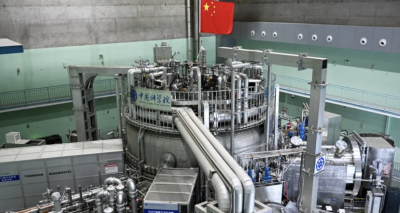
Fusion researchers in China have reported a major advance in tokamak operation by sustaining plasma at densities well above the long-standing Greenwald limit. The experiment on the EAST tokamak in Hefei reached a stable state with plasma density up to 1.65 times the usual threshold, a result that could help future fusion reactors move closer to burning plasma and ignition.
What the Greenwald limit means
The Greenwald limit is a practical density threshold in tokamak reactors. It links maximum plasma density to plasma current and machine size. When reactors exceed it, the plasma often becomes unstable and can disrupt. For decades, this limit has constrained efforts to increase fuel density inside magnetic confinement devices.
How the EAST team achieved the result
The team used two main methods:
- Electron cyclotron resonance heating during start-up to heat electrons before the plasma current was fully ramped up.
- Higher initial deuterium gas input, followed by hydrogen fuel injection as the plasma heated.
They also used lithium coating on tungsten surfaces to reduce impurities. This lowered wall sputtering and helped keep the plasma cleaner and more stable.
Why the plasma stayed stable
The experiments showed a cooler divertor, the region where plasma meets reactor walls. A lower divertor temperature reduced tungsten contamination from the walls. Less impurity in the plasma meant fewer heat losses and a better chance of maintaining high density. The results matched plasma-wall self-organisation theory, which predicts a density-free regime where the plasma can exceed the Greenwald limit.
Significance for fusion power
The EAST experiments do not yet solve fusion power generation. They were conducted at relatively low power and for only a few seconds. However, they show a practical route to higher-density operation in tokamaks. If density can be raised further, future reactors may need lower temperature or shorter confinement time to reach ignition. The finding is relevant for ITER and other next-generation fusion devices, including India’s broader fusion research plans.
Last Modified: April 26, 2026