
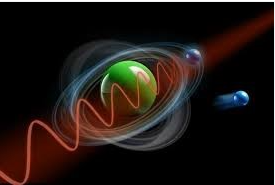
Quantum researchers have demonstrated entanglement between helium atoms through their motion, showing that even relatively heavy particles can obey the same non-classical rules long associated with electrons and other light particles. The experiment involved colliding clouds of helium atoms to produce pairs that shared a single quantum state. This marks an important step in understanding how quantum effects can appear in larger systems and may help in future studies on the relationship between quantum mechanics and gravity.
What Was Demonstrated
The study achieved momentum entanglement, a form of quantum linkage in which two particles share connected momentum states. After the helium clouds collided, the atom pairs moved apart. Until measured, neither atom had a fixed direction of motion. Once the momentum of one atom was measured, the momentum of its partner could be determined immediately, even at a distance.
Why It Matters
Entanglement is one of the most important features of quantum physics. It shows that particles can remain linked in ways that do not fit classical ideas of separate objects acting only through direct contact. The result strengthens evidence that quantum behaviour is not limited to very small particles and can be observed in more complex atomic systems.
Scientific Significance
The experiment may support future research on the boundary between quantum theory and gravity, one of the major unresolved problems in physics. It also adds to the study of nonlocality, where the state of one particle is connected to another without any visible physical signal passing between them.
Key Concepts
- Quantum entanglement links particles into a shared state.
- Momentum entanglement concerns the motion of particles.
- Measurement of one particle helps determine the state of the other.
- The finding extends quantum studies to heavier atomic systems.