
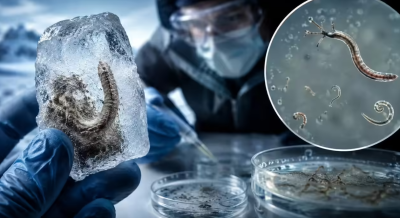
Scientists revived a microscopic freshwater animal called a bdelloid rotifer that had been frozen in Siberian permafrost for approximately 24,000 years. Researchers extracted the organism from ice cores collected near the Alazeya River in northeastern Siberia. The rotifer survived this extended period by entering a state of cryptobiosis, a metabolic shutdown that protects against extreme cold and oxygen deprivation. After thawing in a laboratory setting, the organism successfully resumed biological activity and began reproducing asexually. The study, published in the journal Current Biology, was conducted by the Soil Cryology Laboratory in Pushchino, Russia, shifting scientific understanding of long-term multicellular survival.
Biology and Characteristics of Bdelloid Rotifers
Bdelloid rotifers are microscopic, multicellular invertebrates found primarily in freshwater environments, damp soils, and mosses globally. They possess a complex anatomical structure despite their minute physical dimensions.
Physical Structure and Feeding Mechanism
These organisms typically measure between 150 to 700 micrometers in length. They feature a specialized ciliated structure at the anterior end called a corona, which rotates to draw water and organic particles into their digestive tract. They possess a specialized grinding jaw known as a mastax to process food.
Asexual Reproduction via Parthenogenesis
Bdelloid rotifers have reproduced without sexual interaction for millions of years. They propagate exclusively through obligate parthenogenesis, a form of asexual reproduction where unfertilized eggs develop directly into viable female offspring. This reproductive strategy makes them a key focus for evolutionary biologists studying genetic diversity without sexual recombination.
Mechanisms of Long-Term Survival
The ability of the rotifer to survive for millennia in sub-zero conditions stems from specialized physiological adaptation mechanisms.
Cryptobiosis and Anhydrobiosis
When environmental conditions deteriorate, bdelloid rotifers undergo cryptobiosis, a state where all measurable metabolic processes cease entirely. A specific form called anhydrobiosis allows them to survive near-complete dehydration by purging cellular water and protecting their internal structures from mechanical collapse.
Cellular Protection Systems
During freezing, ice crystals can pierce cell membranes and cause fatal tissue damage. Rotifers counteract this by synthesizing specialized protectant molecules. These substances stabilize proteins and nucleic acids, preventing degradation while the organism remains inactive. They also possess efficient DNA repair mechanisms that fix cellular radiation damage upon rehydration.
Permafrost and Cryopreservation Dynamics
The permafrost environment acts as a natural preservation vault, freezing biological specimens over geological timescales.
Character of Siberian Permafrost
Permafrost refers to ground that remains continuously at or below 0°C for at least two consecutive years. The Alazeya River region in northeastern Siberia features deep, stable permafrost layers that have remained undisturbed since the Late Pleistocene epoch, shielding trapped organisms from structural damage and heat fluctuations.
Verification via Radiocarbon Dating
To establish the exact age of the revived organism, scientists used accelerator mass spectrometry radiocarbon dating on the surrounding organic matter within the soil layer. The analysis confirmed that the permafrost sample settled between 23,960 and 24,485 years ago, validating the rotifer’s ancient origins.
Comparison of Long-Term Survival Across Organisms
| Organism Type | Classification | Approximate Maximum Documented Survival | Key Mechanism |
| Bdelloid Rotifer | Multicellular Invertebrate | 24,000 Years | Cryptobiosis / DNA Repair |
| Nematode (Roundworm) | Multicellular Invertebrate | 46,000 Years | Cryptobiosis / Trehalose synthesis |
| Moss (Chorisodontium) | Non-Vascular Plant | 1,500 Years | Cellular regeneration |
| Bacterial Spores | Single-celled Microorganism | Millions of Years | Endospore formation |
Ecological Implications of Permafrost Thawing
The revival of ancient life forms highlights potential ecological and environmental transformations driven by rising global temperatures in the Arctic.
Re-emergence of Ancient Microorganisms
As global warming causes permafrost layers to melt, organisms locked in deep ice are entering active ecosystems. While rotifers pose no threat to modern life, the melting process can release ancient pathogenic bacteria, viruses, or fungi that have been dormant for thousands of years, potentially exposing modern species to unfamiliar pathogens.
Carbon Feedback Loops
The thawing of Arctic permafrost does more than reanimate dormant biology. It exposes vast quantities of trapped organic matter to microbial decomposition. This process releases substantial volumes of methane and carbon dioxide into the atmosphere, accelerating the global greenhouse effect.
IASPOINT Booster Facts for UPSC
- Soil Cryology Laboratory: Located in Pushchino, Russia, this institution specializes in studying viable microorganisms and multicellular life forms preserved in permafrost layers.
- Late Pleistocene Epoch: The geological time period spanning from roughly 129,000 to 11,700 years ago, characterized by repeated glacial cycles and the presence of megafauna.
- Tardigrades (Water Bears): Another class of microscopic invertebrates famous for cryptobiosis, capable of surviving extreme pressure, vacuum, and radiation, though their documented permafrost survival times are currently shorter than nematodes and rotifers.
- Anoxybiosis: A form of cryptobiosis triggered by a total lack of oxygen, during which organisms rely on alternative internal stabilization pathways to survive without respiration.
- Yedoma: A specific type of organic-rich, ice-filled permafrost found across Siberia and Alaska that formed during the late Pleistocene, which is highly vulnerable to rapid thermokarst melting.