
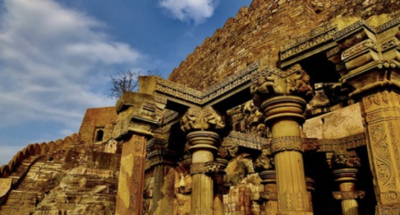
The hill region surrounding Kalinjar Fort in Banda has been declared a National Geo-Heritage Site by the Geological Survey of India. The recognition marks the area’s rare geological features, ancient history and tourism potential. Kalinjar lies in the Vindhya mountain range and is known for its massive fort walls, temples from the Gupta period and strong links with religious and cultural traditions.
Geological Significance
The site is notable for the Eparchaean Unconformity, a rare geological contact where rock layers from very different periods meet. It shows 2.5-billion-year-old Bundelkhand granite overlain by 1.2-billion-year-old Kaimur sandstone. This makes the region important for understanding Earth’s ancient geological history.
Historical and Cultural Importance
Kalinjar Fort has deep historical roots. It is associated with the Chedi dynasty, the Maurya period and references in Buddhist literature. The fort is also linked with legends of Lord Shiva and the Samudra Manthan. The Neelkanth Mahadev temple is among the best-known shrines in the complex. The fort’s stones were sourced locally, reflecting the close link between geology and heritage.
Heritage Protection and Tourism
The geo-heritage status is expected to support conservation of the site’s geological and cultural assets. Officials have also indicated that the recognition may strengthen tourism in the region. Kalinjar is likely to be developed as part of a wider tourism circuit connecting Kalinjar, Khajuraho and Chitrakoot. A special information board has been installed to create awareness about the site’s scientific and historical value.
Exam Relevance
The declaration is for questions on geo-heritage conservation, Indian geology, cultural landscapes and sustainable tourism. It also shows how scientific recognition can support heritage management and regional development.
Last Modified: April 29, 2026