
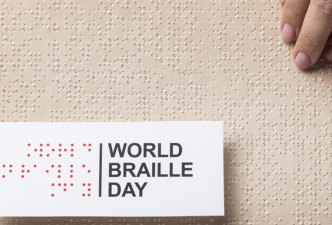
World Braille Day is observed on 4 January to mark the birth anniversary of Louis Braille, the French inventor of the Braille reading system. Braille is a tactile code of six raised dots that enables persons with visual impairment to read, write and access information independently. It remains one of the most important tools for accessibility, education and inclusion across the world.
Origin of Braille
Braille was created in 1824 by Louis Braille, who was born on 4 January 1809. The system was designed to help blind and visually impaired people read through touch. Over time, it has been adapted into many languages and is now used globally.
Uses and Importance
Braille is used for a wide range of daily and academic tasks. It helps in:
- Reading books, newspapers and labels.
- Writing shopping lists and personal notes.
- Solving mathematical problems and scientific equations.
- Learning music and other specialised subjects.
Braille supports independence and dignity for visually impaired persons.
Observance and Awareness
A commemorative function was organised in New Delhi by the National Federation of the Blind. The federation also launched a joint Braille campaign titled More Braille More Empowerment. The campaign aims to strengthen access, equality and inclusion for visually impaired persons.
Accessibility and Inclusion
Braille is closely linked to the right to education, justice and full participation in society. It remains relevant even after two centuries because it provides direct access to information without dependence on others. World Braille Day marks the need for accessible systems in public life, education and governance.
Last Modified: April 25, 2026