
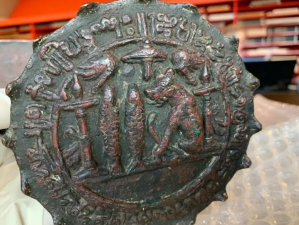
During a bilateral meeting in The Hague on May 16, 2026, the Netherlands government returned the 11th-century Anaimangalam Copper Plates, popularly known as the Leiden Plates, to India. Prime Minister Narendra Modi and Dutch Prime Minister Rob Jetten oversaw the formal repatriation of these Chola-era artifacts. The Colonial Collections Committee of the Netherlands recommended their unconditional return after an investigation concluded that the Dutch East India Company (VOC) involuntarily removed the plates from Nagapattinam between 1687 and 1700. The plates had been kept at Leiden University Library since 1862.
Epigraphical and Physical Features
The Anaimangalam Copper Plates are official legal, administrative, and royal charters issued by the monarchs of the Chola Empire. They serve as unalterable state records of land grants, tax exemptions, and royal lineages.
- Physical Structure: The collection weighs nearly 30 kilograms and consists of two separate sets totaling 24 plates.
- The Larger Plates: A set of 21 large copper sheets issued during the reign of Rajendra Chola I. It contains five sections in Sanskrit and 16 sections in Tamil.
- The Smaller Plates: A supplementary set of three small copper sheets issued later under Kulottunga Chola I.
- Bilingual Composition: The text employs two distinct languages and scripts. The Sanskrit portions are written in the Grantha script to describe the mythical and historical genealogy of the Chola rulers. The Tamil portions record the exact operational boundaries, revenue terms, and conditions of the land grant.
- The Royal Seal: The plates are strung on a massive bronze ring secured by an intricate royal insignia. The seal visually depicts Chola suzerainty over contemporary powers:
- The Chola Tiger: Seated upright, representing the ruling dynastic emblem.
- Twin Fish: The dynastic emblem of the Pandyas.
- The Bow: The dynastic emblem of the Cheras.
- Auspicious Motifs: The white royal umbrella (parasol), two fly-whisks (chamaras), ceremonial lamps, and a swastika symbol.
Historical and Geopolitical Context
The inscriptions record a major land grant to the Chudamani Vihara, a Buddhist monastery in the coastal port town of Nagapattinam. The monastery was built in 1006 CE by King Sri Mara Vijayotunga Varman of the Sailendra Dynasty, rulers of the Srivijaya Kingdom (modern-day Sumatra, Java, and the Indonesian archipelago).
- The Imperial Endorsement: Emperor Rajaraja Chola I orally granted the land revenues and 8,943 kalam of paddy from Anaimangalam village to sustain the Buddhist monastery.
- The Physical Execution: Following the death of Rajaraja I, his son and successor Rajendra Chola I formalised the oral vow into the written copper-plate charter.
- The Supplementary Grant: The three smaller plates detail a subsequent diplomatic appeal by two Javanese emissaries during the reign of Kulottunga Chola I, resulting in an additional grant of 4,500 kalam of paddy to the Buddhist sangha.
Insights into Chola Administration
The Tamil text provides extensive information regarding local self-governance, agrarian economics, and land administration during the early medieval period.
- Land Categories: The grant is classified as a Pallichchandam, which refers to tax-exempt land given explicitly to non-Hindu religious institutions such as Buddhist viharas or Jaina basadis.
- Boundary Delimitation: The inscriptions document a formal ritual where a female elephant was released to walk the perimeter of Anaimangalam village to map out its exact territorial limits.
- Agrarian Supervision: The plates explicitly define specific water distribution rights, irrigation channel management, and local tax exemptions (pariharas).
- Local Assemblies: The text records the precise administrative duties expected from the local village assemblies, including the Sabha (Brahmin assembly) and the Ur (general non-Brahmin assembly).
| Feature | The Larger Leiden Plates | The Smaller Leiden Plates |
| Issuing Monarch | Rajendra Chola I (Executing the vow of Rajaraja I) | Kulottunga Chola I |
| Timeline | Early 11th Century CE | Late 11th Century CE |
| Plate Count | 21 Large Plates | 3 Small Plates |
| Languages Used | Sanskrit (Grantha Script) and Tamil | Tamil |
| Core Subject | Allocation of Anaimangalam village revenues to Chudamani Vihara | Additional paddy allocations following Javanese diplomatic appeal |
IASPOINT Booster Facts for UPSC
- Religious Pluralism: The plates prove the pluralistic state policy of Chola emperors. While Rajaraja I and Rajendra I were devout Saivites who built massive Hindu structures like the Brihadisvara Temple, they actively funded and protected Buddhist monasteries linked to maritime trading partners.
- Maritime Hub: Nagapattinam was a major commercial hub in the Indian Ocean trade network. Over 350 historic Buddha bronzes have been excavated from this region since 1856, confirming its long-standing status as a center of Mahayana Buddhism.
- Paduveli Gopuram: The structural remains of the Chudamani Vihara survived on the Tamil Nadu coast as a dilapidated tower known locally as the Paduveli Gopuram until Jesuit missionaries dismantled it in 1867.
- Other Major Chola Copper Plates:
- Anbil Plates: Issued by Sundara Chola, providing early dynastic lineages.
- Tiruvalangadu Plates: Issued by Rajendra Chola I, detailing his military expedition to the Ganges River.
- Karandai Plates: A massive set of 57 copper plates recording Rajendra I’s military campaigns and land distribution to over a thousand Brahmins.