
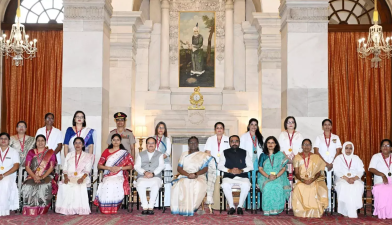
President Droupadi Murmu presented the National Florence Nightingale Awards 2026 to 15 nursing professionals at Rashtrapati Bhavan, New Delhi, on 12 May 2026. This date marks International Nurses Day and commemorates the birth anniversary of Florence Nightingale. The Union Minister of Health and Family Welfare attended the event to recognize outstanding service in clinical care, public health, nursing education, and health administration. The ceremony highlighted the government’s goal to honor excellence across central, state, and union territory health networks, emphasizing the role of nursing workers in maintaining public health systems.
Overview and Institutional Framework
Origin and Governance
The National Florence Nightingale Awards are the highest national honors given to nursing professionals in India. The Ministry of Health and Family Welfare established the awards in 1973. The primary objective is to recognize and reward public health service, devotion to duty, and innovative patient care practices.
Selection Mechanism
The administrative process relies on a two-tier evaluation framework:
- State Level Selection: State and Union Territory Selection Committees screen initial applications. These bodies include representatives from the Department of Health and Family Welfare and the Trained Nurses Association of India.
- Central Level Selection: The Central Selection Committee, functioning under the Indian Nursing Council, finalizes the nationwide list of awardees.
Eligibility Criteria and Award Components
Categorization of Professionals
The institutional guidelines divide eligibility into three distinct professional categories. Candidates must have a minimum of 10 years of service in government, private, missionary, or voluntary medical organizations.
- Registered Nurses and Midwives (RN & RM)
- Registered Auxiliary Nurses and Midwives (ANM)
- Registered Lady Health Visitors (LHV)
Structure of the Honor
Each selected awardee receives a uniform recognition package during the presidential ceremony:
| Component | Specification | Purpose |
| Certificate of Merit | Formal citation signed by government authorities | Official documentation of professional milestones |
| Medal | Specially minted commemorative medal | Symbolic physical token of national gratitude |
| Cash Prize | Value of 1,00,000 rupees | Financial reward for meritorious public service |
Legacy of Florence Nightingale
Historical Profile and Warfare Contributions
Florence Nightingale (1820–1910) was an English social reformer, statistician, and the pioneer of modern secular nursing. She gained global prominence during the Crimean War (1853–1856), where she organized care for wounded soldiers at the military hospital in Scutari, Constantinople. Her practice of inspecting wards during late hours earned her the title “The Lady with the Lamp.”
Statistical and Institutional Reforms
Nightingale transformed healthcare from an untrained occupation into a disciplined medical profession through systemic structural updates:
- Sanitation and Hygiene: She introduced strict ventilation, clean water access, and waste management practices, reducing hospital mortality rates caused by preventable infections.
- Data Visualization: As a skilled statistician, she developed the Coxcomb or polar area diagram to visually demonstrate that bad sanitation caused more soldier deaths than actual battlefield wounds.
- Formal Education: In 1860, she established the Nightingale Training School at St Thomas’ Hospital in London, the first scientific school dedicated to nursing curriculum. Her textbook, Notes on Nursing, established standard education protocols globally.
National Policy Initiatives for Nursing Sector
The Government of India is pursuing multiple legislative and physical infrastructure programs to upgrade the nursing workforce alongside annual recognition schemes.
National Nursing and Midwifery Commission Act
This regulatory legislation aims to replace the legacy Indian Nursing Council framework. The Act modernizes educational standards, maintains a transparent national registry, and implements standardized training quality controls across private and public nursing institutions.
Co-located Nursing Colleges
The state is setting up 157 new nursing colleges across various districts. These institutions are co-located with existing government medical colleges. This plan ensures that nursing students receive immediate practical training within operational tertiary healthcare centers, optimizing resource deployment and bridging regional healthcare access gaps.
IASPOINT Booster Facts for UPSC
- International Nurses Day Context: Celebrated globally on May 12, the 2026 theme emphasizes strengthening health systems via the workforce, highlighting how empowered nursing personnel stabilize primary and tertiary emergency care lines.
- Avian Counterpart Trivia: In the field of ecology, the European and Red-necked Nightjars are nocturnal birds that rely on lunar illumination to forage, displaying behavior patterns distinct from human-centric diurnal schedules.
- The Coxcomb Diagram: This mathematical innovation by Florence Nightingale was one of the earliest recorded uses of pie charts with varying sector lengths to alter public policy regarding military field hygiene.
- Indian Nursing Council Statutory Status: Established under the Indian Nursing Council Act of 1947, this statutory body regulates the basic structure of nursing education in India, though it is currently transitioning under the new Commission framework.
- Auxiliary Nurse Midwives (ANMs) Role: ANMs function as the frontline health workers in rural India, serving as the critical link between village communities and Primary Health Centres (PHCs) for maternal care and immunization drives.