
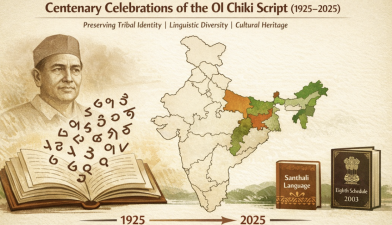
The centenary celebrations of the Ol Chiki script mark 100 years since its creation for the Santhali language. The initiative marks the script’s role in preserving tribal identity, improving literacy, and strengthening written expression for one of India’s major indigenous languages. Santhali is spoken across Jharkhand, Odisha, West Bengal, Assam and Bihar, and belongs to the Austroasiatic language family.
Inaugural Ceremony
The inaugural function is being held at Dr Ambedkar International Centre, New Delhi, on 16 February 2026. The Ministry of Culture is organising the event in collaboration with a Santhali monthly newspaper. The President of India is the Chief Guest. The Union Ministers for Tribal Affairs and Culture and Tourism are also attending.
Programme Highlights
The centenary event includes:
- A special exhibition on the Ol Chiki script.
- A short film on the script’s history and significance.
- Release of a commemorative coin.
- Release of a commemorative postage stamp.
- A cultural programme celebrating Santhali heritage.
About Ol Chiki Script
Ol Chiki was developed in 1925 by Pandit Raghunath Murmu. It was designed exclusively for Santhali and contains 30 letters. The script represents sounds more accurately than borrowed scripts such as Roman, Bengali, Odia and Devanagari. It captures distinctive phonetic features, including glottal stops and special vowel patterns. This made it suitable for standardised writing, teaching and publication.
Historical and Constitutional Significance
Pandit Raghunath Murmu is regarded as the architect of the script. His work helped transform Santhali from an oral tradition into a written language. The first book in Ol Chiki, High Serena, was published in 1936. A major milestone came in 2003, when Santhali was included in the Eighth Schedule of the Constitution through the 92nd Constitutional Amendment Act. This gave the language formal recognition and expanded its use in education, governance and research. The Constitution of India was later translated into Santhali using Ol Chiki, further strengthening linguistic inclusion.
Last Modified: April 28, 2026