
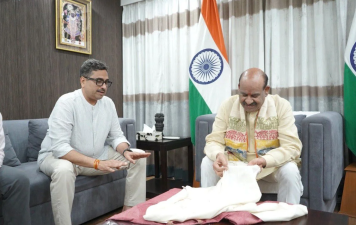
An initiative has been launched to create a premium blended fabric by combining Rajasthan’s traditional Kota Doria with Northeast India’s Eri silk. This cross-regional partnership aims to strengthen the global identity of Indian handlooms and boost the livelihoods of rural artisans. The project blends the lightweight, translucent weave of Kota Doria with the thermal comfort and soft texture of Eri silk to target premium domestic and international fashion markets. The collaboration aligns with the government’s “5F Vision” to enhance the textile value chain and is being formalized through an agreement between regional handloom development bodies.
Core Components of the Collaboration
The partnership brings together two distinct textile heritages from different geographic zones of India. The primary entities formalizing this project are the North Eastern Handicrafts and Handlooms Development Corporation (NEHHDC) and Rajasthan’s District Industries Centre (DIC).
The 5F Vision Alignment
The project directly implements the central government’s “5F” formula designed to strengthen the textile sector. The components of this vision include:
- Farm: Production of raw cotton, wool, and silk by farmers.
- Fiber: Processing raw materials into spinning-ready fibers.
- Fabric: Weaving and knitting fibers into textiles.
- Fashion: Designing garments for contemporary consumer tastes.
- Foreign: Exporting the finished apparel to international markets.
Strategic Objectives
- Product Diversification: Creating a unique material that offers the structure of Kota Doria with the texture of silk.
- Market Expansion: Introducing northeastern silk variants to western Indian weaving clusters and vice versa.
- Income Enhancement: Increasing the per-meter value of handloom products to provide higher wages to weavers and silkworm rearers.
Profile of Kota Doria
Kota Doria is a traditional open-weave fabric manufactured at Kaithoon in the Kota district of Rajasthan, as well as in nearby villages.
Structural Characteristics
The fabric is characterized by a distinctive square check pattern known as Khat. These checks are intentionally created by interlacing different counts of cotton and silk yarns during the weaving process. The cotton yarn provides strength and structure, while the silk yarn lends transparency and a subtle sheen.
Geographical Indication Status
Kota Doria received Geographical Indication (GI) protection in 2005. This status ensures that only fabrics produced using traditional methods in the designated Kota region can legally use the name.
Profile of Eri Silk
Eri silk is a wild silk variety predominantly produced in the northeastern states of India, with Assam being the primary hub.
The Ahimsa Silk Concept
Eri silk is widely known as “peace silk” or “Ahimsa silk.” Unlike traditional mulberry silk production, the extraction of Eri silk does not involve killing the silkworm. The moths leave the cocoon naturally before the cocoons are processed and spun into yarn.
Material Properties
The silk is derived from the silkworm Samia ricini, which feeds primarily on castor leaves (Ricinus communis). The resulting fabric possesses unique thermal properties, making it warm in winter and cool in summer. It has a wool-like texture and blends easily with other natural fibers.
Comparative Analysis of the Blending Components
| Feature | Kota Doria | Eri Silk |
| Primary Region | Kota district, Rajasthan | Northeast India (Assam, Meghalaya) |
| Source Material | Cotton and Mulberry Silk blend | Samia ricini silkworm (Castor fed) |
| Texture & Weight | Lightweight, sheer, crisp feel | Soft, dense, wool-like texture |
| Distinctive Feature | Khat (square check) patterns | Cruelty-free extraction (Ahimsa Silk) |
| GI Status Tag | Registered in 2005 | Assamese Eri Silk registered in 2009 |
IASPOINT Booster Facts for UPSC
- Four Varieties of Silk: India is the only country that produces all four commercial varieties of silk: Mulberry, Tasar, Muga, and Eri.
- Muga Silk Monopoly: Assam holds near-exclusive global production rights for Muga silk, which received its GI tag due to its natural golden color and durability.
- Central Silk Board (CSB): A statutory body established in 1948 under the Ministry of Textiles, Government of India, to coordinate silk industry development.
- National Handloom Day: Celebrated annually on August 7 to commemorate the Swadeshi Movement launched on that date in 1905.
- GI Tag Act: Geographical Indications are governed by the Geographical Indications of Goods (Registration and Protection) Act, 1999, which is administered by the Controller General of Patents, Designs, and Trade Marks.