
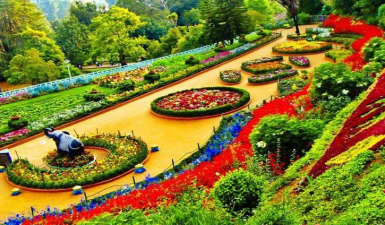
The 128th edition of the annual Ooty Flower Festival commenced at the Government Botanical Garden (GBG) in Udhagamandalam (Ooty), Nilgiris district, Tamil Nadu. Organised by the Tamil Nadu Department of Horticulture and Plantation Crops, the 11-day exhibition forms the focal point of the Nilgiris District Summer Festival. Running until May 28, the event showcases international plant varieties alongside massive horticultural installations designed around indigenous Tamil cultural themes. Local administrations have implemented strict traffic regulations, introduced mandatory e-passes for incoming vehicles, and deployed enhanced security grids to manage the massive influx of domestic and international tourists.
Core Highlights and Structural Exhibits
The festival utilizes over ten lakh flowers and 50,000 flower pots to curate large-scale replicas celebrating the architectural and ecological heritage of Tamil Nadu.
Cultural and Architectural Installations
- Five Tamil Landscapes (Ainthinai): Elaborate setups mapping the ancient Sangam classification of landscapes: Kurinji (mountainous), Mullai (forested), Marudham (agricultural), Neithal (coastal), and Paalai (arid).
- Iconic Landmarks: A replica of the entrance to Chennai Central Railway Station built using over one lakh carnation flowers.
- Heritage Structures: Detailed floral representations of the Mamallapuram Shore Temple, the Tiruvarur temple chariot, and a Nilgiri Mountain Railway (NMR) steam engine.
Botanical Diversity on Display
- Global Sourcing: Cultivation of nearly 275 ornamental plant varieties grown from seeds imported from multiple countries.
- Specialised Exhibits: Re-opening of the renovated Cactus House and Glass House featuring rare, exotic succulent and flowering species.
- Horticultural Artistry: Dedicated sections displaying carefully nurtured Bonsai trees, intricate vegetable carvings, and fruit sculptures.
The Nilgiris Summer Festival Ecosystem
The Flower Show does not operate in isolation but acts as the anchor event for a month-long circuit of agricultural and cultural exhibitions across the hill station.
| Event Name | Primary Venue | Focus Area |
| Ooty Flower Show | Government Botanical Garden, Ooty | Exotic blooms, floral replicas, landscape artistry |
| Rose Show | Government Rose Garden, Ooty | Display of thousands of indigenous and hybrid rose varieties |
| Fruit Show | Sims Park, Coonoor | Sculptures made from locally harvested and rare fruits |
| Vegetable Show | Nehru Park, Kotagiri | Artistic arrangements of cool-climate hill vegetables |
| Spice Show | Gudalur | Exhibition of plantation spices like clove, cardamom, and pepper |
| Ooty Boat Race | Ooty Lake | Competitions managed by the Department of Tourism, Tamil Nadu |
Government Botanical Garden: Institutional Profile
The venue hosting the festival holds immense historical and botanical value within the Indian subcontinent.
Historical Evolution
- Establishment: Founded in 1848 by William Graham McIvor, a curator sent from the Royal Botanic Gardens, Kew, England.
- Design Paradigm: Laid out in a classic Victorian terraced design, ascending the slopes of Dodabetta Peak at an elevation of roughly 2,200 to 2,500 meters above sea level.
- Colonial Purpose: Originally established to cultivate European vegetables and plants for the residents of the Madras Presidency at a subsidized cost.
Key Territorial Divisions inside the Garden
- Lower Garden: Expansive lawns housing the main glasshouse and the designated spot for the central festival installations.
- New Garden: Area consisting of domestic rose varieties, carpet beds, and natural ponds.
- Italian Garden: Formed by Italian prisoners of war during World War I who were stationed in India; features formal beds arranged around an octagonal bandstand.
- Fossil Tree Trunk: A preserved 20-million-year-old fossilized tree trunk embedded in the center of the garden, highlighting ancient geological history.
IASPOINT Booster Facts for UPSC
- Nilgiri Biosphere Reserve: The Nilgiris district is a core component of the Nilgiri Biosphere Reserve, which was the first biosphere reserve designated in India under UNESCO’s Man and the Biosphere (MAB) Programme in 1986. It encompasses parts of Tamil Nadu, Kerala, and Karnataka.
- Sangam Landscape Concept (Thinaigal): The representation of the five landscapes at the festival directly links to Sangam literature, where each geographical zone represents a distinct ecological character, presiding deity, and corresponding human emotion.
- Nilgiri Mountain Railway (NMR): The floral replica of the NMR engine represents a UNESCO World Heritage Site. Built by the British in 1908, this meter-gauge rack railway relies on an alternate spur-geared system (Abt mechanism) to climb steep gradients.
- The Toda Tribe: The indigenous pastoral community of the Nilgiris, the Todas, traditionally reside near these hills. Their unique barrel-shaped huts (Dogles) and distinctive red-and-black embroidered shawls (Pootkhuly) carry Geographical Indication (GI) protection.
- Administrative Regulators: The event is jointly managed by the Department of Horticulture and Plantation Crops alongside the Tamil Nadu Tourism Development Corporation (TTDC), emphasizing the economic intersection of agriculture and eco-tourism.