
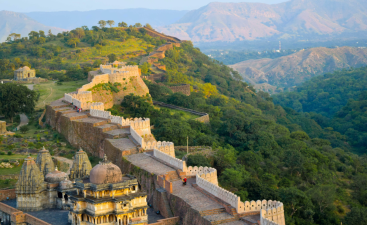
Kumbhalgarh Fort Wall in Rajasthan is now recognized as the second-longest surviving wall in the world, measuring 36 km, after the Great Wall of China. Advances in aerial and satellite mapping have revised the lengths and rankings of ancient walls globally, including Kumbhalgarh’s inclusion. This recognition highlights India’s rich heritage in large-scale military architecture and enhances the fort’s significance for tourism and cultural preservation. The global ranking underscores the importance of protecting such historic monuments.
Historical Genesis and Strategic Geopolitics
Rana Kumbha, the ruler of the Mewar kingdom, commissioned the construction of Kumbhalgarh Fort between 1438 and 1458 AD. The fortress served as the second most favored capital of Mewar after Chittorgarh. It provided a secure refuge for the rulers during times of external invasions. Mandan, a legendary master builder of the 15th century, served as the chief architect. He documented his architectural principles and treatises in the text Rajvallabh. Geographically, the structure rests atop a high peak of the western Aravalli mountain range, standing at an elevation of approximately 1,100 meters (3,600 feet) above sea level. This mountainous location allowed the architect to implement the Rajput military hill architecture style, utilizing the jagged terrain as a natural barrier.
Architectural Elements of the Great Wall of India
The perimeter wall stretches continuously over 36 kilometers, earning the title of the “Great Wall of India.” It is the longest continuous fortification wall wrapped around a single fort complex globally.
Structural Dimensions and Defensive Design
The frontal ramparts present a massive masonry barrier measuring 4.5 meters (15 feet) in thickness. In multiple sections, the top layout widens up to 25 feet, allowing eight horses to march abreast. The masonry consists of large, interlocking dressed stone blocks capable of absorbing shocks from medieval siege weapons. The entire length incorporates solid, rounded bastions or attalakas that project outward, providing a wider field of view for archers and guards. Tapered openings or crenels (kanguras) line the top perimeter, protecting defensive troops during active counter-attacks.
Fortified Gateways and Internal Access Control
The entry layout incorporates seven massive, heavily fortified gateways known as Pols. Each consecutive gateway features narrower passages and sharp, right-angled bends designed to restrict the movement of enemy cavalry and war elephants.
- Aaret Pol: The initial entry gateway situated at the base slope.
- Halla Pol: Built on the downward slope to slow down forced charges.
- Hanuman Pol: A double-storeyed gateway featuring octagonal bastions, housing a stone idol of Lord Hanuman brought by Rana Kumbha.
- Other Major Gateways: Ram Pol, Vijay Pol, Bhairav Pol, Nimbu Pol, and Pagda Pol guard the upper lines of defense.
Internal Complex and Cultural Heritage
The vast enclosed space encompasses a rich mix of military, residential, and religious buildings, illustrating the co-existence of multiple faiths under royal patronage.
Religious Monuments
The fort compound protects over 360 ancient temples. This religious assembly includes 300 ancient Jain temples and 60 Hindu shrines. Key structures include:
- Vedi Temple: A sacrificial three-storeyed stone structure built by Rana Kumbha to commemorate the completion of the fortress.
- Neelkanth Mahadev Temple: Dedicated to Lord Shiva, featuring a massive monolithic black stone lingam.
- Parsva Natha Temple: A prominent Jain temple constructed around 1513 AD.
Royal Palaces and Water Conservation
The highest point of the fortress houses the Badal Mahal (Palace of Clouds) and the Kumbha Palace. These structures feature double-storeyed layouts, arched windows, and beautiful frescoes. For water security during prolonged sieges, the fort utilizes stepwells and massive tanks. The Badshahi Bavdi is a stepped tank built after the 1578 invasion by Shahbaz Khan, a general under Mughal Emperor Akbar, to ensure regular water supply for the garrisoned troops.
Comparative Analysis of Ancient Fortifications
The structural uniqueness of Kumbhalgarh stands out when evaluated against other global historical walls.
| Rank | Fortification Name | Geographic Location | Estimated Length | Core Architectural Type |
| 1 | Great Wall of China | Northern China | 21,196 km | Continental Frontier Wall Network |
| 2 | Kumbhalgarh Fort Wall | Rajasthan, India | 36 km | Continuous Fortress Enclosure Wall |
| 3 | Diyarbakir Walls | Diyarbakir, Turkey | 5.8 km | Basalt Urban Defensive Circuit |
| 4 | Walls of Ston | Ston, Croatia | 5.5 km | Limestone Peninsula Barrier Wall |
| 5 | Walls of Avila | Avila, Spain | 2.5 km | Medieval City Circuit Wall |
IASPOINT Booster Facts for UPSC
- Birthplace of Maharana Pratap: Kumbhalgarh Fort is the historic birthplace of Maharana Pratap, the legendary warrior king of Mewar born to Maharana Udai Singh II and Rani Jeevant Kanwar.
- UNESCO World Heritage Site: In 2013, during its 36th session, UNESCO designated Kumbhalgarh Fort as a World Heritage Site under the collective property group “Hill Forts of Rajasthan,” which includes Chittorgarh, Jaisalmer, Ranthambore, Amer, and Gagron.
- Ancient Precursor: Archaeological layers indicate that the fort sits over the ruins of a 2nd-century BC military camp established by King Samprati, a Jain ruler and the grandson of Mauryan Emperor Ashoka.
- Classification of Forts: According to ancient Indian texts like Manusmriti and Kautilya’s Arthashastra, Kumbhalgarh fits the category of a Giri-Durga (Hill Fort), which is considered superior in defensive capability to Jala-Durga (Water Fort) or Dhanva-Durga (Desert Fort).
- Military Vulnerability: The fort remained virtually impregnable throughout its history. It fell only once in 1578 to a combined force of Akbar, Raja Man Singh of Amer, and Mirja Hakim, due to the poisoning of the internal water reservoirs.