
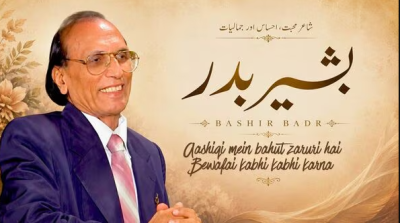
Renowned Urdu poet Bashir Badr passed away at the age of 91 in Bhopal after a prolonged illness. He was celebrated for his modern Urdu poetry, known for its emotional depth and simplicity. Bashir Badr’s couplets have been widely cherished across generations, making him a prominent literary figure. His funeral was held the same day at Kadim Masjid, with burial at Bada Bagh graveyard.
Early Life and Academic Foundation
Bashir Badr was born as Syed Muhammad Bashir on February 15, 1935, in Faizabad (modern-day Ayodhya), Uttar Pradesh. He exhibited a passion for literature from an early age, composing his first couplet at seven years old.
Higher Education and Teaching Career
He pursued his higher studies at Aligarh Muslim University (AMU), where he completed his Bachelor of Arts, Master of Arts, and Doctor of Philosophy (PhD). His doctoral thesis was titled “Azadi Ke Bad Urdu Ghazal Ka Tanqidi Mutala” (A Critical Study of Urdu Ghazal after Independence). Following his academics, Badr served as a lecturer at AMU and later moved to Meerut College, where he worked as the Head of the Urdu Department for nearly 17 years.
Literary Style and Contributions
Bashir Badr is recognized as a pioneer of the modern Urdu ghazal. He broke away from the traditional, highly complex vocabulary of classical Urdu poetry to make the art form accessible to the general public.
The People’s Poet
His poetic style relied heavily on simple, colloquial words, everyday imagery, and deep emotional resonance. This approach earned him the reputation of a “People’s Poet.” His ghazals focused on contemporary human experiences, including love, loneliness, displacement, dignity, and communal harmony.
Major Published Works
- Ikai: One of his foundational collections of ghazals.
- Aas: The acclaimed poetry collection that won national recognition.
- Aamad and Aahat: Notable anthologies exploring themes of arrival, longing, and memory.
- Image and Kulliyate Bashir Badr: Comprehensive compilations of his life’s work.
- Ujale Apni Yadon Ke: A specialized edition of his ghazals published in the Devanagari script to reach Hindi readers.
Literary Criticism
Apart from creative writing, Badr authored two major books of literary criticism: Azadi Ke Bad Urdu Ghazal Ka Tanqidi Mutala and Biswin Sadi Mein Ghazal (Ghazals in the 20th Century).
Historical Challenges and Relocation
A defining turning point in Badr’s life occurred during the 1987 Meerut communal riots. His house, personal library, and numerous unpublished manuscripts were completely destroyed in a fire. This severe personal tragedy forced him to relocate permanently to Bhopal, Madhya Pradesh. The trauma of losing his lifelong work influenced his subsequent poetry, infusing it with subtle themes of exile, loss, and human vulnerability without making his tone bitter.
Awards and Public Recognition
Badr received top institutional honors for his exceptional contribution to Indian literature and linguistics.
National Honors
- Padma Shri (1999): Awarded by the Government of India for his distinguished service to literature and education.
- Sahitya Akademi Award (1999): Bestowed by India’s National Academy of Letters for his Urdu poetry collection Aas.
Administrative Leadership
He also served as the Chairman of the Bihar Urdu Academy, contributing to the promotion and preservation of the Urdu language at the state level.
Impact on Indian Culture and Politics
Badr’s verses transcended literary circles to become embedded in Indian pop culture and political discourse.
Political Rhetoric
His couplets have been frequently quoted by prominent political leaders within the Parliament of India to emphasize diplomacy, coexistence, and social unity. For instance, his 1972 couplet, “Dushmani jam kar karo lekin ye gunjaish rahe, jab kabhi hum dost ho jaayein to sharminda na hon” (Engage in enmity thoroughly, but leave room so that if we ever become friends, we do not feel ashamed), became widely associated with the spirit of the historic Shimla Agreement between India and Pakistan.
Pop Culture Integration
The title of the long-running radio show Ujaale Apni Yaadon Ke on Vividh भारती was adapted directly from one of his famous lines. Additionally, modern Indian cinema has featured his poetry to depict characters with a deep appreciation for independent literary arts.
IASPOINT Booster Facts for UPSC
- Evolution of the Ghazal: The ghazal is a classical poetic form consisting of rhyming couplets (Sher), where each couplet is structurally independent but shares a common meter (Beher) and a refrain. Bashir Badr, along with contemporary poets like Nida Fazli and Rahat Indori, democratized the post-Independence Indian ghazal by replacing classical Persianized vocabulary with Hindustani words.
- Constitutional Status of Urdu: Urdu is recognized as one of the 22 languages listed under the Eighth Schedule of the Constitution of India. It belongs to the Indo-Aryan family of languages and is written in the Perso-Arabic script.
- Sahitya Akademi: Established in 1954, the Sahitya Akademi is an autonomous organization under the Ministry of Culture. It recognizes outstanding literary merit in 24 languages, which includes the 22 languages of the Eighth Schedule along with English and Rajasthani.
- Padma Awards: Instituted in 1954, these awards are announced annually on Republic Day. They are given in three categories: Padma Vibhushan (exceptional and distinguished service), Padma Bhushan (distinguished service of high order), and Padma Shri (distinguished service). The awards are presented by the President of India.