
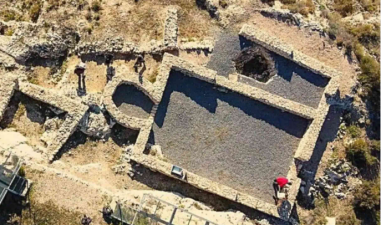
A fortified hilltop complex at El Monastil in southeastern Spain has been identified as a rare Byzantine stronghold from the late sixth century. The discovery suggests direct Eastern Roman control deep inside Iberia during a contested frontier period. The site combined military, religious and administrative functions within one enclosure, making it an important case for the study of Byzantine presence in the western Mediterranean.
Site Location and Strategic Value
El Monastil stands on a hill above the Vinalopó corridor near Elda. Its position allowed control over movement through a narrow passage and observation of routes linked to the Roman road network. The site was also close to important centres such as Ilici and Cartagena, which made it valuable as a frontier post.
Military and Administrative Evidence
Archaeologists found two iron plates from lamellar armour, indicating the presence of a mounted Byzantine soldier. They also recovered seven bronze weights, one of the largest known Byzantine sets from the Iberian Peninsula. These weights suggest official administrative activity, likely linked to taxation and church oversight under Justinianic practice.
Church and Imported Objects
Inside the enclosure stood a small church with a horseshoe-shaped apse and a baptismal pool cut into bedrock. Painted plaster shows that it was carefully finished. Marble from Greece once formed the altar, and an ivory pyx decorated with a classical scene reflects the wider Mediterranean cultural world of the Byzantine Empire. The evidence points to a compact but religious centre.
Later Transformations and Historical Importance
Around AD 600, Visigothic control replaced Byzantine rule and the church briefly became a bishop’s seat. A bishop of Elo is documented in 610, but the seat disappeared within a few decades. The complex later returned to monastic use and was eventually reshaped by Muslim settlers. The site is rare because it combines defence, worship, administration and reuse across several political phases.
Last Modified: April 27, 2026