
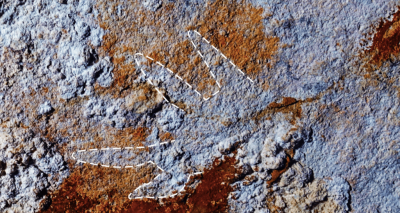
A hand stencil from Liang Metanduno cave on Muna Island, off the coast of Sulawesi in Indonesia, has been dated to at least 67,800 years ago. This makes it the oldest known example of rock art identified so far anywhere in the world. The discovery pushes back the timeline for symbolic expression in Southeast Asia and adds to evidence that early humans in Wallacea created complex imagery far earlier than once thought.
Discovery in Liang Metanduno Cave
The artwork was found in a limestone cave in southeastern Sulawesi, a region that has received less archaeological attention than the Maros-Pangkep karst area in southwest Sulawesi. Researchers documented 44 rock art sites across the region and dated 11 motifs from eight sites. These included hand stencils, figurative images and geometric designs.
How the Age Was Determined
The age was established through uranium-series analysis of calcite deposits that formed directly over the pigment. Laser ablation methods showed that the mineral layer above the stencil was about 71,600 years old, giving the painting a minimum age of 67,800 years. In some cases, carbonate layers beneath the pigment were also studied to narrow the likely time window.
Significance for Human Prehistory
The finding is important for understanding early human movement in the region. During the Pleistocene, lower sea levels linked Australia, New Guinea and Tasmania into Sahul. The new date supports the view that humans with symbolic traditions were present in Wallacea before or during the first settlement of Sahul. It also strengthens arguments for early maritime migration across island chains between Borneo and Papua.
Distinctive Features of the Artwork
The stencil is unusual because the fingers were deliberately narrowed after the hand outline was made, creating a claw-like form. Such modification is rare in known rock art. Researchers suggest it may reflect symbolic ideas linking humans and animals. Later paintings at the site indicate that artistic activity in the cave continued for tens of thousands of years.
Last Modified: April 28, 2026