
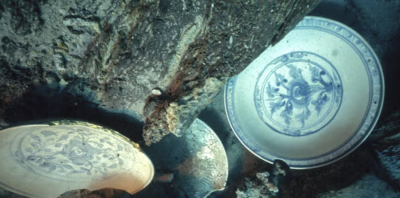
A 14th century shipwreck in waters off Singapore has yielded a major cargo of Yuan Dynasty blue-and-white porcelain, offering fresh evidence of maritime trade between China and Temasek, the historic settlement on the site of modern Singapore. The wreck, estimated to be about 650 years old, contained one of the largest known hauls of Yuan porcelain recovered from a single site.
Discovery and Excavation
Marine archaeologists spent four years investigating the shallow wreck site. Strong currents and poor visibility made diving difficult. The vessel itself had largely disintegrated, but the cargo remained scattered across the seabed. Researchers recovered about 3.5 metric tons of ceramic shards, including around 136 kilograms of Yuan porcelain and several intact or near-intact pieces.
Porcelain Designs and Dating
The recovered ceramics included distinctive blue-and-white motifs such as:
- Four-clawed dragons
- Phoenixes surrounded by chrysanthemums
- Mandarin ducks in a lotus pond
The mandarin duck motif helped date the wreck. It was associated with Emperor Wenzong, who restricted its use during his reign from 1328 to 1332. The likely production window also fits the late Yuan period, before the dynasty fell in 1368 and commercial restrictions tightened under the early Ming period.
Trade Networks and Historical Significance
The cargo is important for understanding the maritime Silk Routes under Mongol rule. The porcelain was made in China using cobalt that originated from Persia, showing the wide reach of Eurasian trade networks. The ship likely sailed from Quanzhou on China’s eastern coast to Temasek, which was then a duty-free port and an active trading centre.
Archaeological and Cultural Value
The find marks the scale of consumption and wealth in 14th century Temasek. It also underlines the technological and artistic importance of Yuan blue-and-white porcelain, which later became one of the most influential traditions in Chinese ceramic history.
Last Modified: April 28, 2026