
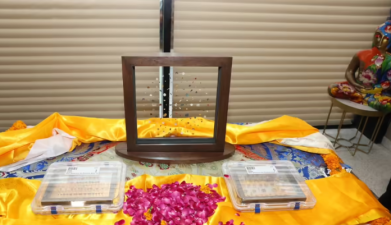
The sacred Piprahwa relics are set to arrive in Leh on Buddha Purnima, marking a major moment of cultural and civilisational significance. The relics include bone fragments, reliquary caskets, crystal, soapstone, ornaments, and funerary objects linked with the Buddha. Unearthed in 1898 at Piprahwa in present-day Uttar Pradesh, they are widely associated with the Sakya clan, the Buddha’s own people. Their repatriation to India in 2025, after 127 years abroad and following an attempted auction in Hong Kong, has renewed attention on India’s Buddhist heritage and Ladakh’s historical role in its transmission.
Piprahwa Relics and Repatriation
- The relics were discovered at Piprahwa in 1898.
- They are among the most important Buddhist finds in India.
- The collection includes sacred remains and associated ritual objects.
- Their return is seen as an act of cultural recovery.
Ladakh as a Buddhist Corridor
Ladakh was historically a key civilisational route linking India with China, Central Asia, and the wider Buddhist world. Buddhism moved through Kashmir and Gandhara into Ladakh and onwards through trans-Karakoram routes to the Tarim Basin, including Khotan. Along these routes travelled monks, manuscripts, art styles, and religious ideas. This makes Ladakh more than a strategic border region; it was also a major heritage landscape.
Archaeological Legacy in Ladakh
- Ancient stupas and inscriptions survive across Ladakh and Kargil.
- Rock carvings and sculptures reflect links with Kashmir and Gandhara.
- Sites in Suru, Dras, and Khaltse show early Buddhist presence.
- The Maitreya sculpture at Mulbek is among the best-known examples.
Significance for Buddhist Diplomacy
The relics’ veneration in Leh marks the need to view Ladakh as a heritage zone. It strengthens India’s civilisational diplomacy by connecting present-day policy with historical Buddhist networks. The event also underlines the importance of preserving frontier regions as repositories of India’s cultural memory.
Last Modified: April 28, 2026