
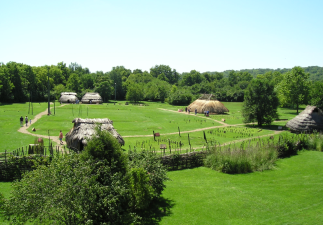
SunWatch Indian Village, a reconstructed 13th-century settlement belonging to the Fort Ancient culture, provides insights into pre-contact Native American life along the Great Miami River in Dayton, Ohio. Discovered in the 1960s during preliminary municipal excavations, salvage operations began in 1971 to protect the area from planned wastewater treatment plant expansions. The site preserves the exact archaeological footprint of the original village, which was occupied for approximately 40 years. Listed on the National Register of Historic Places in 1975 and designated a National Historic Landmark in 1990, it operates as an open-air museum supporting ongoing research.
Culture and Chronology of the Fort Ancient People
Temporal and Spatial Distribution
The Fort Ancient culture refers to a distinct group of Native American people who inhabited the middle Ohio River Valley, encompassing parts of modern-day southern Ohio, northern Kentucky, southeastern Indiana, and western West Virginia. Their civilization flourished during the Late Prehistoric Period, spanning from approximately 1000 AD to 1650 AD.
Societal Transition
The Fort Ancient culture evolved out of the local Late Woodland culture. Unlike their Hopewell predecessors, who focused heavily on geometric earthwork construction and wide-ranging trade networks, Fort Ancient communities shifted toward intensive agriculture and nucleated, permanent village settlements.
Architectural Layout and Structural Components
Circular Village Plan
SunWatch Indian Village demonstrates a highly organized, circular settlement pattern typical of middle Fort Ancient communities. The village layout reflects a clear social stratification and functional zoning:
| Village Zone | Physical Structure / Contents | Primary Function |
| Outer Perimeter | Defensive Stockade | A wall of wooden posts providing protection and defining community boundaries. |
| Residential Ring | Rectangular Daub-and-Wattle Houses | Domestic spaces featuring thatched roofs, bark walls, and central hearths. |
| Sub-Surface Pits | Storage and Refuse Cavities | Initially used to store surplus maize; later repurposed for trash disposal. |
| Central Plaza | Open Public Space and Burial Grounds | Communal gatherings, ceremonial activities, and structured interments. |
Astronomical Solar Calendar
At the exact center of the plaza, archaeologists discovered a system of large wooden posts arranged to form an astronomical solar calendar. The Fort Ancient people used the shadow alignments cast by these central poles against outer perimeter markers to track seasonal changes. This system accurately identified the summer solstice, winter solstice, and planting or harvesting intervals, which were essential for their agricultural cycle.
Subsistence Strategy and Technology
Agriculture and the Three Sisters
The economy of the Fort Ancient culture relied heavily on the cultivation of maize (corn), which made up a large portion of their diet. They practiced companion planting by cultivating the “Three Sisters” crops together in the same mounds:
- Maize: Provided a sturdy stalk for climbing plants.
- Beans: Fixed nitrogen in the soil to nourish the crops.
- Squash: Developed wide leaves that shaded the ground, conserving soil moisture and preventing weed growth.
Foraging and Tools
The community supplemented its agricultural yield by hunting local fauna, particularly white-tailed deer and wild turkey, and gathering freshwater mussels from the Great Miami River. Their tool kit included triangular flint arrowheads, bone awls for leatherworking, and grit-tempered ceramic vessels decorated with incised geometric lines or cord-marked patterns.
IASPOINT Booster Facts for UPSC
- Mississippian Influence: While distinct, the Fort Ancient culture existed concurrently with the Mississippian culture to their west and adopted several cultural traits, such as shell-tempered pottery and specific artistic motifs, through trade.
- National Historic Landmark Status: In the United States, National Historic Landmarks are officially designated by the Secretary of the Interior because they possess exceptional value in illustrating the heritage of the country.
- The Serpent Mound Connection: Though originally attributed entirely to the earlier Adena culture, radiocarbon dates from portions of the famous Ohio Serpent Mound suggest that the Fort Ancient people may have modified or refurbished the effigy mound around 1070 AD.
- Decline and Dispersal: The Fort Ancient culture disappeared as a distinct archaeological entity by the mid-17th century. This disruption was likely caused by European infectious diseases spreading ahead of direct contact and the structural displacement associated with the Beaver Wars.