
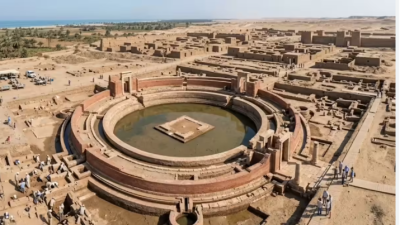
An Egyptian archaeological team has concluded excavations at Tell el-Farama in northern Sinai and identified a rare round temple inside the ruins of ancient Pelusium. The structure, first uncovered in 2019, was earlier thought to be an administrative building. New evidence has now shown that it was a religious complex linked to water use and worship. The site dates to the second century AD and remained in use until the sixth century AD.
Temple Reinterpreted as Religious Site
Archaeologists found hydraulic features that changed the understanding of the structure. These include drainage systems, cisterns and multiple entrances. Such features indicate a specialist religious function rather than a civic or political one. The temple is now believed to have been dedicated to the local deity Pelusius.
Distinctive Circular Design
The temple has a diameter of about 35 metres, or roughly 65 feet. Its main feature is a circular basin that would have stored Nile water for ritual and practical use. A square base likely supported a large statue of the deity. Fired red brick, commonly used in Roman hydraulic works, helped preserve the structure over centuries.
Historical and Cultural Significance
Pelusium was an important city and port on the eastern edge of Egypt for more than a thousand years. It served as a gateway for travellers entering Egypt from the Sinai route. The temple reflects a blend of ancient Egyptian, Greek and Roman architectural traditions. The use of Nile water in the complex also marks the religious importance of purification, fertility and cosmic balance in ancient Egyptian belief systems.
Last Modified: April 27, 2026