
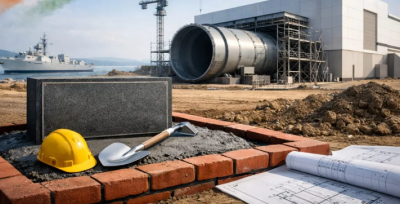
India has laid the foundation stone for a state-of-the-art Large Cavitation Tunnel (LCT) facility at the Naval Science & Technological Laboratory (NSTL), DRDO, in Visakhapatnam. The project is designed to strengthen indigenous naval research, improve testing capacity, and support India’s push for self-reliance in defence technology. It is expected to become a key national asset for hydrodynamic research and underwater systems development.
Strategic Significance
The LCT will help India design, develop, and test naval equipment, systems, and sub-systems within the country. It will reduce dependence on foreign testing facilities. The facility is also expected to improve propulsion research, noise reduction, and stealth capabilities. These areas are critical for submarines and modern warships.
Role in Naval Engineering
The tunnel will support the design and development of next-generation ships, submarines, and underwater platforms. It will enable precise validation of hydrodynamic designs and propulsion systems. The facility is also expected to benefit major naval platforms such as destroyers and aircraft carriers. This will strengthen India’s shipbuilding ecosystem and maritime defence preparedness.
Advanced Testing Capabilities
The LCT is being developed in turnkey mode with international technical collaboration. It is intended to provide both closed-loop simulations for submarine studies and free surface simulations for surface ship research in one integrated setup. This makes it a rare and highly advanced infrastructure for naval testing. It will improve the quality and speed of indigenous innovation in maritime technology.
Broader Defence Context
During the visit, advanced underwater systems such as torpedoes, naval mines, decoys, and autonomous underwater vehicles were displayed. A swarm demonstration of man-portable AUVs brought into light India’s progress in autonomous maritime operations. The project reflects the wider goal of Aatmanirbhar Bharat in defence, with support from scientists, industry, academia, MSMEs, and researchers.
Last Modified: April 28, 2026