
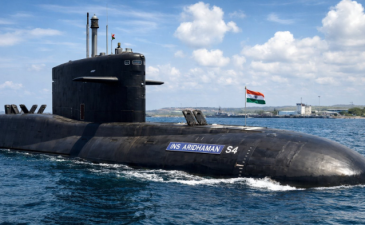
India has inducted its third nuclear-powered ballistic missile submarine, INS Aridhaman, strengthening its sea-based nuclear deterrent. The induction marks an important step in India’s effort to maintain a credible second-strike capability under its nuclear doctrine. The advanced stealth frigate INS Taragiri was also commissioned at Visakhapatnam on the same occasion.
What INS Aridhaman Adds
INS Aridhaman is a 7,000-tonne Arihant-class SSBN and is larger and more advanced than INS Arihant and INS Arighaat. It is fitted with eight vertical launch tubes and can carry more nuclear-capable missiles. Its missile load can include:
- K-15 submarine-launched ballistic missiles with a range of up to 750 km.
- K-4 nuclear-capable SLBMs with a range of about 3,500 km.
- Up to eight K-4 missiles or as many as 24 K-15 missiles.
Role in Nuclear Triad
INS Aridhaman strengthens India’s nuclear triad, which consists of nuclear delivery systems from land, air and sea. India’s land-based missiles include the Agni series, while air-delivered capability can be provided by fighter aircraft such as Rafale, Su-30MKI and Mirage 2000. SSBNs are especially important because they ensure survivability after a first strike and support credible retaliation.
Strategic Significance
India follows a no first use nuclear doctrine and relies on deterrence and retaliation. A ballistic missile submarine at sea is difficult to detect and can remain submerged for long periods. This makes it a key element of assured second-strike capability. With three operational SSBNs, India can improve patrol continuity and reduce vulnerability of its nuclear forces.
Future SSBN and SSN Plans
India’s fourth SSBN, codenamed S4*, is under construction and is expected to carry more K-4 missiles. The Navy is also pursuing nuclear-powered attack submarines. It plans to build two indigenously and lease one from Russia as an interim measure. These developments aim to widen undersea deterrence and strengthen maritime security.
Last Modified: April 28, 2026