
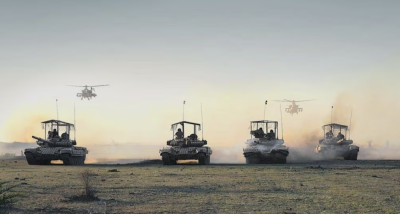
The Indian Army’s Southern Command conducted Exercise Amogh Jwala at the Babina Field Firing Ranges, showcasing high-tempo mechanised operations in a multi-domain environment. The drill focused on the integrated use of attack helicopters, fighter aircraft, drones, counter-drone systems and advanced battlefield technologies. It brought into light the Army’s push towards a more networked and future-ready force.
Key Features of the Exercise
- The exercise synchronised fire and manoeuvre in realistic battlefield conditions.
- It used real-time drone-enabled surveillance and target acquisition.
- Precision engagement formed a central part of the operational drill.
- Night-fighting capabilities were also tested during the exercise.
Multi-Domain Warfare Focus
The exercise reflected the increasing importance of multi-domain operations in modern warfare. It integrated Electronic Warfare, Air Defence and aerial platforms with ground manoeuvres. The drill also demonstrated the role of intelligence, surveillance and reconnaissance in improving battlefield awareness and decision-making.
Operational Significance
Exercise Amogh Jwala showed how mechanised forces can operate with greater speed, coordination and precision. The use of drones and counter-drone systems underlined the need to respond to emerging aerial threats. The exercise also emphasised the growing relevance of technology absorption in strengthening combat capability.
Command Emphasis on Readiness
The Army Commander brought into light professionalism, operational excellence and battle readiness during the exercise. He stressed that jointness across land, air, cyber and space domains is essential for building an agile force. The exercise reinforced the Army’s focus on adapting to the evolving battlespace across the full spectrum of operations.
Last Modified: April 29, 2026