
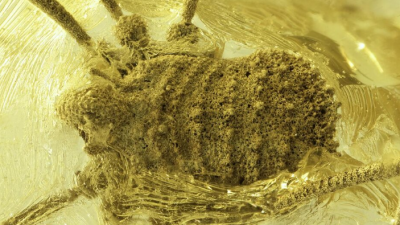
A previously unknown harvestman species has been identified from 35-million-year-old amber from Ukraine and the Baltic region. The fossil belongs to an extinct arachnid lineage that no longer survives in Europe . The discovery adds to the known diversity of amber-preserved species and offers new evidence on the ancient distribution of harvestmen during the Eocene epoch.
New Species Identified
The fossil has been named Balticolasma wunderlichi. It was assigned to the Ortholasmatinae subfamily, a group of harvestmen known for their ornamented bodies and complex head structures. Until now, no fossil member of this subfamily had been documented.
Advanced Imaging Reveals Details
Researchers used computed tomography and X-ray imaging to study the specimen in three dimensions. The scans revealed:
- Fine ridges across the upper body.
- A prominent eye mound.
- Intricate mouthparts with multiple appendages.
- Surface textures similar to those seen in living relatives.
Amber Fossils and Ancient Distribution
The specimen was preserved in tree resin that hardened into amber, protecting delicate anatomical features over millions of years. The fossil shows that ortholasmatine harvestmen were once more widely distributed across the Northern Hemisphere. Today, their living relatives are found only in East Asia, North America and Central America.
Significance for European Fossil Record
The discovery strengthens the view that Baltic and Ukrainian amber deposits preserve closely related ancient faunas. It also increases the number of known harvestman species from Baltic amber to 19 and from Rovno amber to seven. Six species are shared between the two deposits, suggesting similar ecosystems in the region during the Eocene.
Last Modified: April 27, 2026