
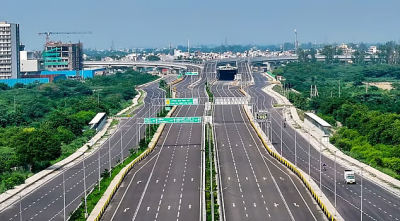
India launched its first Multi-Lane Free Flow (MLFF) barrier-less tolling system on May 1, 2026, at the Choryasi Toll Plaza on the Surat–Bharuch section of National Highway 48 (NH 48) in Gujarat. The National Highways Authority of India (NHAI) implemented this pilot project at a cost of fifteen crore rupees following successful trials that began in February 2026. The Choryasi plaza handles approximately twenty-five thousand vehicles daily and generates around sixty lakh rupees in revenue per day. This initiative aims to eliminate traffic congestion and improve toll collection efficiency, serving as a blueprint to upgrade over one thousand toll plazas nationwide by the end of 2026.
Core Technology and Mechanisms
The barrier-less tolling system removes physical boom barriers and toll booths, allowing vehicles to pass through the plaza without stopping or slowing down.
Automatic Number Plate Recognition (ANPR)
High-definition, high-speed cameras are installed on overhead gantries across the highway. These cameras capture front and rear license plates of vehicles traveling at speeds up to 80 kilometers per hour. The system uses artificial intelligence and optical character recognition to read number plates in varying weather and lighting conditions.
Advanced FASTag Integration
The system integrates ANPR with the existing Radio Frequency Identification (RFID) based FASTag network. When a vehicle passes the gantry, the RFID reader detects the FASTag while the ANPR camera verifies the registration plate. The toll amount is automatically deducted from the linked prepaid wallet or bank account. If a FASTag is invalid or lacks sufficient balance, the ANPR system logs the vehicle details for enforcement and recovery.
National Highway 48 Profile
The pilot project is strategically located on NH 48, which is one of the busiest and most critical economic corridors in India.
- Connectivity: NH 48 connects major metropolitan cities including Delhi, Jaipur, Ahmedabad, Surat, Mumbai, Pune, Bengaluru, and Chennai.
- Economic Importance: The Surat–Bharuch section in Gujarat is a high-density freight and passenger corridor that connects major industrial hubs, ports, and chemical clusters.
- Traffic Density: The Choryasi plaza handles a high volume of commercial multi-axle trucks and passenger vehicles, making it an ideal testing ground for free-flow technology.
Comparison of Toll Collection Systems
| Features | Manual Toll Collection | RFID FASTag System | Multi-Lane Free Flow (MLFF) |
|---|---|---|---|
| Physical Barriers | Yes (Boom barriers at every lane) | Yes (Boom barriers open after scan) | No (Open gantries without barriers) |
| Vehicle Speed | 0 km/h (Complete stop) | 5–10 km/h (Slow down for scan) | Up to 80 km/h (Non-stop) |
| Processing Time | 30–60 seconds per vehicle | 10–15 seconds per vehicle | Near-instantaneous (Free flow) |
| Primary Technology | Cash / Receipts | RFID Tags & Readers | ANPR, RFID, & AI Integration |
| Congestion Levels | High | Moderate during peak hours | Minimal to zero |
Benefits and Challenges of MLFF Implementation
The transition to barrier-less tolling brings distinct operational advantages along with regulatory and infrastructure hurdles.
Operational Advantages
- Reduced Fuel Consumption: Eliminating stop-and-go driving at toll plazas reduces fuel wastage and lowers vehicular carbon emissions.
- Time Efficiency: Non-stop movement through plazas decreases travel time for freight logistics and passenger transport.
- Logistical Efficiency: Faster turnaround times for commercial vehicles lower overall supply chain costs across economic corridors.
- Lower Maintenance Costs: Fewer physical booths and mechanical barriers reduce long-term wear and tear expenses for highway operators.
Implementation Challenges
- Enforcement and Non-Compliance: Implementing a legal framework to penalize vehicle owners who pass through without active FASTags or valid registration plates.
- Data Privacy and Security: Protecting the massive volume of vehicular movement data and license plate images from cyber threats.
- High Initial Capital: Setting up high-speed gantries, specialized cameras, and centralized AI processing servers requires significant initial capital.
- Weather Dependability: Ensuring ANPR cameras maintain high accuracy during heavy monsoon rain, dense fog, or dust storms.
IASPOINT Booster Facts for UPSC
- Nodal Agency: The National Highways Authority of India (NHAI), an autonomous agency under the Ministry of Road Transport and Highways (MoRTH) established via the NHAI Act, 1988, is the executing agency.
- FASTag Background: India made FASTag mandatory for all M and N categories of vehicles from January 1, 2021, operating on the National Electronic Toll Collection (NETC) mechanism developed by the National Payments Corporation of India (NPCI).
- AI Integration: The MLFF system utilizes Edge AI processing to match the physical dimensions of the vehicle with its registered class to prevent toll evasion by vehicle category mismatch.
- National Highway Renumbering: NH 48 was created by merging old NH 8 (Delhi-Mumbai) and old NH 4 (Mumbai-Chennai) during the rationalization of highway numbers in 2010.