
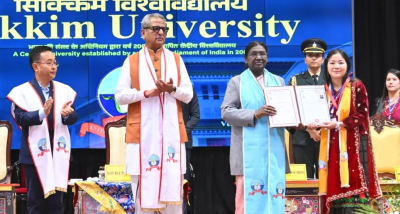
Sikkim has been officially declared a fully literate state under the central government’s ULLAS initiative, marking a historic achievement in its educational and developmental trajectory. The formal declaration was made by Chief Minister Prem Singh Tamang during the seventh convocation of Sikkim University at Manan Kendra in Gangtok, in the presence of President Droupadi Murmu. By achieving a literacy rate of 99.82 percent, Sikkim surpassed the 95 percent benchmark set by the Union Ministry of Education to qualify for fully literate status. This achievement places Sikkim as the fifth state or Union Territory in India and the third in the Northeast region to accomplish this educational standard under the national program.
Overview of the Literacy Achievement in Sikkim
The elevation of Sikkim to a fully literate state follows targeted local operations and community participation under the New India Literacy Programme.
Statistical Breakdown and Benchmarks
- Literacy Percentage: Sikkim recorded a functional literacy rate of 99.82 percent among its eligible population.
- National Benchmark: The Ministry of Education mandates that a state or Union Territory can be declared fully literate when it crosses a minimum threshold of 95 percent literacy. The remaining 5 percent accounts for unfeasible margins due to advanced age, relocation, or intellectual disabilities.
- Regional Ranking: Sikkim follows Mizoram and Tripura to become the third state in the Northeastern region of India to achieve full literacy status. Nationally, it joins the ranks of other fully literate jurisdictions like Ladakh, Mizoram, Goa, Tripura, Himachal Pradesh, Chandigarh, and the Andaman and Nicobar Islands.
Implementation Framework
The literacy drive, tagged locally as “Saakshar Sikkim”, mobilized resources across all levels of local administration. Gram panchayats, block administrative centres, and urban local bodies identified non-literate individuals aged 15 and above. The state education department utilized public schools as basic functional units to organize teaching schedules, register learners on the digital database, and coordinate learning evaluations.
Understanding the ULLAS Initiative
The Understanding of Lifelong Learning for All in Society (ULLAS) initiative is a centrally sponsored scheme designed to align adult education with the National Education Policy (NEP) 2020.
Scheme Profile and Objectives
The initiative, also known as the Nav Bharat Saaksharta Karyakram, covers the financial years 2022 to 2027 with a target to empower 5 crore non-literate citizens aged 15 years and above across the country. It shifts the institutional focus from traditional “Adult Education” to the more inclusive term “Education for All”.
Structural Changes in Literacy Assessment
ULLAS changes the criteria for literacy verification from a signature-only standard to an operational assessment of real-life skills.
| Core Component | Focus Area and Functional Output |
| Foundational Literacy and Numeracy | Ability to read local text, write functional sentences, and perform basic mathematical calculations. |
| Critical Life Skills | Training in financial literacy, legal awareness, digital tool usage, disaster management protocols, healthcare, and child care. |
| Basic Education | Preparing adult learners for equivalent preparatory (Class III–V), middle (Class VI–VIII), and secondary (Class IX–XII) certificate qualifications. |
| Vocational Skills | Imparting industry-relevant training, upskilling, and reskilling in collaboration with local skill departments to aid livelihood generation. |
| Continuing Education | Access to structured resource centers for physical, cultural, sports, and recreational education. |
Operational Model
- Volunteerism (Kartavyabodh): The scheme functions via citizen-led volunteer teachers, including school students, NCC cadets, NSS volunteers, and community members.
- Hybrid Learning Mode: Imparts instruction using physical primers along with digital delivery through the ULLAS Portal and Mobile Application.
- Evaluation (FLNAT): Functional Literacy and Numeracy Assessment Tests (FLNAT) are conducted twice a year in local schools. The final certificates of literacy are issued under the joint authorization of the National Institute of Open Schooling (NIOS) and the Department of School Education and Literacy (DoSEL).
Socio-Economic Impact of Full Literacy in Sikkim
The attainment of 99.82 percent literacy carries multi-sectoral advantages for the socio-economic framework of Sikkim.
Enhancing the Premium Organic Economy
Sikkim became India’s first 100 percent organic certified state in 2016. High adult literacy allows farmer producer organizations (FPOs) and small landholders to utilize advanced agricultural traceability technologies, maintain formal financial accounts, and manage international export documentations. This directly supports the state’s ongoing mission to transition into a globally integrated premium organic economy.
Gender Empowerment and Inclusive Public Systems
Women make up nearly 60 percent of graduating students and 70 percent of academic medal winners in higher education institutions in the state. Achieving full functional literacy among older age groups ensures that adult women can effectively access specialized state welfare systems. This includes safely utilizing modern transport systems such as the newly launched women-only “Pink City Runner” (Aama-Didi-Bahini Bus Sewa) bus service in Gangtok, which operates at half-fares.
IASPOINT Booster Facts for UPSC
- Constitutional Provisions for Literacy: Education is a subject in the Concurrent List (List III) of the Seventh Schedule of the Constitution of India, inserted via the 42nd Constitutional Amendment Act of 1976. Article 21A makes free and compulsory education for children aged 6 to 14 a Fundamental Right, whereas Article 45 (Directive Principles of State Policy) and Article 51A(k) (Fundamental Duties) also guide educational governance.
- Census Criteria for Literacy: According to the Census of India, a person aged seven and above who can both read and write with understanding in any language is considered literate. A person who can only read but cannot write is not counted as literate.
- Sikkim Statehood History: Sikkim formally joined the Indian Union as the 22nd state on May 16, 1975, through the 36th Constitutional Amendment Act. It shares international borders with three nations: Bhutan, China, and Nepal, and a state border with West Bengal.
- Implementing Agencies of ULLAS: The scheme is executed at the central level by the Department of School Education and Literacy (DoSEL) under the Ministry of Education, supported by the National Council of Educational Research and Training (NCERT). At state levels, it functions through State Literacy Mission Authorities (SLMA).