
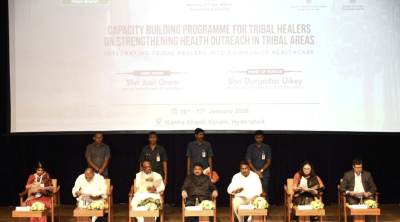
India will launch its first National Capacity Building Programme for Tribal Healers in Hyderabad on 16–17 January 2026. The initiative aims to formally recognise tribal and indigenous healers as community-level partners in public health. It also seeks to strengthen health outreach in tribal areas through training, institutional support, and evidence-based coordination.
Key Objective of the Programme
The programme is designed to build a bridge between traditional healing systems and the public health framework. It will focus on:
- Capacity building of tribal healers.
- Improved referral and sensitisation practices.
- Community-based health outreach in remote tribal regions.
- Ethical and structured engagement with indigenous knowledge systems.
Major Institutional Collaboration
A key feature of the event is the signing of an MoU between the Ministry of Tribal Affairs and ICMR–Regional Medical Research Centre, Bhubaneswar. This will establish India’s first National Tribal Health Observatory, named Bharat Tribal Health Observatory under Project DRISTI. The observatory will support tribe-disaggregated health surveillance, implementation research, and disease elimination efforts in tribal districts.
Health Data and Research Focus
The new observatory will address a major gap in tribal-specific health data. It will develop a secure digital platform with dashboards and GIS-enabled analytics. It will also support the Bharat Tribal Family Health Survey and research linked to national programmes on tuberculosis and vector-borne diseases. This is expected to improve planning, monitoring, and targeted intervention in tribal regions.
Broader Tribal Health Context
The Ministry of Tribal Affairs has been working on tribal health through the National Sickle Cell Anaemia Elimination Mission, convergence with malaria, leprosy, and tuberculosis programmes, and infrastructure expansion in tribal areas. The new initiative aligns with PM JANMAN and DAJGUA. It reflects a shift towards combining indigenous healing systems with modern public health delivery for sustainable outcomes in PVTG and other tribal areas.
Last Modified: April 26, 2026