
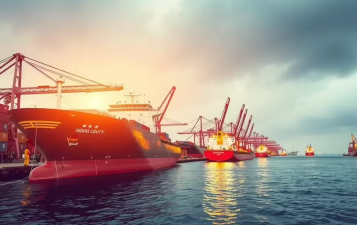
Union Minister for Ports, Shipping and Waterways Sarbananda Sonowal chaired a high-level review meeting to finalize a reform-driven roadmap aimed at accelerating India’s maritime transformation. The initiative aligns directly with the “Viksit Bharat 2047” national vision to establish India as a dominant global maritime superpower. To mark this policy shift, the ministry announced the nationwide “Maritime Reform Utsav” to celebrate 12 years of core structural updates across ports, shipping lines, and inland waterways. The strategy addresses structural updates by focusing on digital integration, ease of doing business, human resource development, and inter-agency coordination.
Operational Framework of the 2026 Reforms
The Maritime Reform Utsav
The Ministry of Ports, Shipping and Waterways (MoPSW) launched this nationwide initiative to evaluate the development achieved over the last 12 years. The campaign serves as an administrative review and gap-analysis exercise to evaluate ongoing infrastructure progress against long-term national targets. It tracks key progress metrics in seven distinct operational fields:
- Major and minor port performance indices.
- Commercial shipping and fleet expansion.
- Inland Waterways Transport (IWT) modal share.
- Coastal community infrastructure development.
- Green shipping and decarbonization commitments.
- E-governance and operational digitization.
- Regional and international maritime connectivity corridors.
Unified Digital Ecosystem
The Directorate General of Shipping (DGS) has been tasked with building an integrated digital platform and complementary mobile application. This software infrastructure uses data-driven governance to remove bureaucratic delays. The system unifies real-time service delivery pipelines, digital documentation verification, and direct grievance handling into a single interface accessible to international and domestic maritime operators.
Institutional Monitoring Architecture
The ministry mandated the immediate setup of a dedicated monitoring and coordination committee. This specialized administrative body handles time-bound judicial and operational management, focusing on:
- Expediting long-pending court cases and maritime legal disputes.
- Enforcing a time-bound administrative mechanism for cargo and operator grievances.
- Ensuring structured follow-up on international commitments arising from high-level state visits.
- Tracking department-level performance indicators using outcome-based targets.
Long-Term Strategic Roadmaps and Targets
The maritime reform roadmap incorporates objectives from established policy frameworks designed to expand the capacity of India’s blue economy.
| Policy Vision Document | Implementation Timeline | Core Target Indicators | Planned Fiscal Investment |
| Maritime India Vision (MIV) 2030 | Overlapping to 2030 | 150 initiatives across 10 themes; upgrading key ports to handle 300 MTPA each. | ₹3 Lakh Crore to ₹3.5 Lakh Crore |
| Maritime Amrit Kaal Vision (MAKV) 2047 | Long-term to 2047 | 300 action points; increasing port capacity to 10,000 MTPA; 4x growth in inland cargo. | ₹89 Lakh Crore total required pool |
| Sagarmala Programme | Continuous tracking | Port-led industrialization; 839 identified coastal infrastructure projects. | ₹5.8 Lakh Crore optimized pipeline |
Legal and Structural Modernization Packages
To support these operational reforms, the legislative framework governing Indian waters has been updated through recent draft bills intended to replace colonial-era shipping statutes.
Indian Ports Bill
This legislation repeals the century-old Indian Ports Act of 1908. It establishes the Maritime State Development Council to coordinate planning between the central ministry and coastal state governments, while strengthening state maritime boards to oversee non-major ports.
Merchant Shipping Bill
Designed to replace the Merchant Shipping Act of 1958, this bill simplifies registration for Indian-flagged vessels. It introduces strict statutory updates regarding seafarer welfare, vessel safety protocols, marine pollution control, and faster shipwreck removal operations.
Coastal Shipping Bill
This dedicated framework aims to elevate the domestic modal share of coastal shipping from its current level of 6%. By separating coastal trade regulations from deep-sea international shipping rules, the bill reduces logistics costs by nearly ₹10,000 crore annually.
Carriage of Goods by Sea Bill
This updates legal transport documentation by adopting modern international standards, specifically The Hague-Visby Rules. The updated rules reduce litigation risks for Indian exporters during international trade agreements.
Human Capital and Emerging Technologies
Specialized Maritime Training
The roadmap instructs departments to upgrade training curriculums across national maritime institutions. The updated educational frameworks prioritize training in artificial intelligence applications, automated logistics management, and data systems to prepare human resources for smart port operations.
Green Shipping and Decarbonization
The policy mandates the development of carbon-neutral port facilities under the Maritime Amrit Kaal Vision. Infrastructure adjustments include setting up specialized green hydrogen and green ammonia bunkering terminals at selected major ports to meet international maritime emission standards.
IASPOINT Booster Facts for UPSC
- Sovereign Mantra: The maritime review framework operates under the four-pillar governance philosophy of “Reform, Perform, Transform, and Inform.”
- Mega Port Developments: To achieve the 10,000 MTPA cargo target by 2047, six new deep-water mega ports are planned, led by Vadhavan in Maharashtra and Enayam in Tamil Nadu.
- Capacity Milestones: Over the last decade, major Indian ports increased their total cargo-handling capacity by 87%, supported by operational fast-tracking.
- Key Upgrade Ports: The ports of Paradip (Odisha), Visakhapatnam (Andhra Pradesh), and Ennore (Tamil Nadu) are specifically designated for capacity expansions to cross 300 MTPA handling status by 2030.
- Inland Waterways Target: The cargo handling volume for National Waterways is targeted to increase from current baselines to 500 MTPA by 2047.