
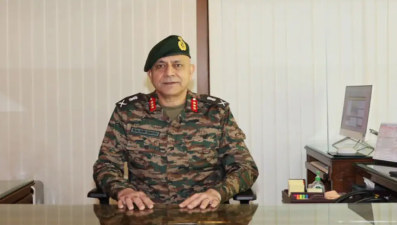
Lieutenant General Balbir Singh assumed command as the General Officer Commanding (GOC) of the 15 Corps, popularly called the Chinar Corps, on 1 May 2026. He succeeds Lieutenant General Prashant Srivastava, who transitioned to New Delhi to take over as the Quarter Master General at Army Headquarters. Headquartered at the Badami Bagh Cantonment in Srinagar, the 15 Corps holds the frontline responsibility for military vigilance along the Line of Control in Kashmir and coordinates internal counter-insurgency grids within the Valley. The structural transition in leadership maintains operational continuation for the Indian Army’s multi-layered security setup in Jammu and Kashmir.
Institutional Profile of the 15 Corps
The 15 Corps is a premier field formation of the Indian Army operating under the operational jurisdiction of the Udhampur-based Northern Command.
Mandate and Area of Responsibility
The administrative boundaries of the Chinar Corps encompass the entire Kashmir Valley. The double-pronged operational mandate includes:
- Counter-Infiltration: Securing the high-altitude Line of Control against external infiltration attempts through physical fencing, anti-infiltration obstacle systems, and electronic surveillance networks.
- Counter-Terrorism: Neutralizing domestic security threats and managing the localized Counter-Insurgency (CI) grid across urban, rural, and forested terrains in cooperation with the Jammu and Kashmir Police, Central Reserve Police Force, and intelligence agencies.
Symbolism and Heritage
The official emblem of the formation is the Chinar leaf, representing the regional geography of the Valley. Upon taking command, the incoming GOC paid homage at the Chinar War Memorial in Srinagar. This monument serves as the institutional repository honoring the fallen soldiers of the formation during historical conventional wars and ongoing internal security assignments.
Operational Leadership and Command Structure
The command profile of Lieutenant General Balbir Singh includes over 34 years of active military service across varied combat environments.
Prior Specialized Postings
The newly appointed commander has specialized experience in the northern theater. His past assignments include:
- Major General General Staff (MGGS) at the Northern Command headquarters.
- Command of the 1 Sector Rashtriya Rifles, a specialized counter-insurgency force segment.
- Leadership of the Counter Insurgency Force (CIF) Victor based in Awantipora, which maintains operational security across South Kashmir.
- Operational deployments handling active counter-insurgency operations in the North East region.
Evolution of Command and Key Formations
The internal counter-insurgency tasks of the Chinar Corps are supported by specialized grid divisions, primarily the Rashtriya Rifles.
| Force Formation | Headquarter Location | Primary Zone of Responsibility |
| Counter Insurgency Force Victor (CIF-V) | Awantipora | South Kashmir Valley (Anantnag, Pulwama, Kulgam, Shopian) |
| Counter Insurgency Force Kilo (CIF-K) | Sharifabad | North Kashmir Valley (Kupwara, Baramulla, Bandipora) |
| 8 Sector Rashtriya Rifles | Lolab, Kupwara | Remote frontier tracking and high-altitude border security pockets |
Recent Operational Context and Tactical Precedents
The command transition follows consecutive structural operations executed by the outgoing leadership to maintain regional stability.
Operation Sindoor
A specialized, proactive cross-border counter-infiltration action executed along the Line of Control. The tactical maneuver targeted active launch pads and neutral zone infrastructure to pre-empt coordinated infiltration attempts during seasonal mountain pass openings.
Operation Mahadev
A coordinated internal security operation executed jointly by the Indian Army, Jammu and Kashmir Police, and the Central Reserve Police Force. The operation tracked and neutralized three high-profile militants connected to the April 22, 2025, Pahalgam attack, which had targeted civilian tourists.
IASPOINT Booster Facts for UPSC
- Operational Commands of Indian Army: The Indian Army functions via seven operational commands. Six are regional commands (Northern, Western, Eastern, Southern, Central, South-Western) and one is a functional training command (ARTRAC located in Shimla).
- The Rashtriya Rifles (RR): Raised in 1990 by then Chief of Army Staff General S.F. Rodrigues, the RR is a dedicated counter-insurgency force drawn from various regiments of the regular Indian Army. Personnel serve on a rotational deputation model.
- Unified Command Structure: In Jammu and Kashmir, internal security operations are structured under a Unified Headquarters chaired by the civilian Chief Minister, with the Corps Commanders of 15 Corps (Srinagar) and 16 Corps (Nagrota) acting as key military advisors.
- Line of Control (LoC) vs. Line of Actual Control (LAC): The LoC is a designated, militarily mapped 740 km boundary separating India and Pakistan-occupied regions, formalized under the 1972 Shimla Agreement. The LAC is the un-demarcated operational boundary separating Indian-controlled areas from Chinese-controlled territories.