
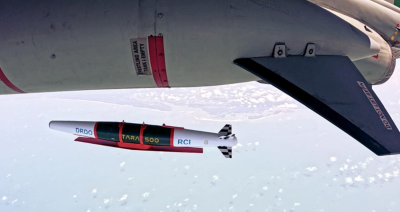
The Defence Research and Development Organisation and the Indian Air Force successfully conducted the maiden flight trial of the Tactical Advanced Range Augmentation weapon system on 7 May 2026 off the coast of Odisha. Launched from a Jaguar fighter aircraft, TARA represents India’s first indigenous glide weapon system designed to transform conventional unguided bombs into precision-guided munitions. This development marks a shift toward scalable, low-cost precision air warfare by utilizing a modular range extension kit. The Defense Ministry confirmed that production has started through domestic Development-cum-Production Partners, paving the way for eventual induction into the armed forces.
Architectural and Technical Mechanics
The TARA system functions as an external add-on modification for existing ordnance rather than a standalone missile structure.
Aerodynamic Glide Apparatus
Unlike standard missiles that depend on heavy, expensive chemical rocket motors, TARA uses aerodynamic glide technology. Upon release from a host aircraft at specific altitudes and speeds, the system deploys integrated foldable wings and specialized control surfaces. The initial kinetic energy and speed provided by the aircraft propel the weapon, allowing it to glide across long distances instead of following a basic gravity-drop trajectory.
Guidance and Navigation Suite
The system maintains high accuracy through a multi-tiered onboard electronics layout.
- Inertial Navigation System (INS): Provides constant autonomous tracking of the weapon’s spatial orientation and acceleration vectors from the point of launch.
- Global Navigation Satellite System (GNSS): Utilizes satellite positioning data to correct mid-course path deviations and counter electronic jamming threats.
- Electro-Optical (EO) / Infrared (IR) Seeker: Actively engages during the terminal terminal phase to locate, identify, and track ground targets, reducing the final Circular Error Probable.
Operational Capabilities and Strategic Value
The deployment of the TARA kit changes the tactical application of legacy inventory and boosts aircraft safety.
Stand-Off Strike Ranges
TARA provides fighter aircraft with a stand-off distance ranging from 80 to 180 kilometers depending on the launch altitude. This allows the delivery platform to release its payload well outside the coverage area of enemy short and medium-range surface-to-air missile systems, lowering the operational risk to pilots and multi-role fighter platforms.
Warhead Compatibility and Cost Efficiency
The modular engineering configuration allows retrofitting onto various High Speed Low Drag unguided gravity bombs. TARA features three weight variants designed to integrate with standard 250 kg, 450 kg, and 500 kg bomb stockpiles. Upgrading these legacy munitions costs an estimated 25 lakh INR per unit, bypassing the financial demands associated with manufacturing completely new air-to-ground guided missile lines.
Comparative Framework: Domestic and Global Stand-Off Weapons
| Weapon System | Country of Origin | Propulsion Type | Maximum Range | Guidance Mechanisms |
| TARA Kit | India | Non-Propelled (Glide) | 80 – 180 km | INS + Satellite + Electro-Optical |
| SAAW (Smart Anti-Airfield Weapon) | India | Glide (Turbojet variant under development) | 100 km (Base variant) | INS + Satellite + Imaging Infrared |
| JDAM-ER | United States | Non-Propelled (Glide) | 70 – 80 km | INS + GPS |
| SPICE-1000 | Israel | Non-Propelled (Glide) | 60 – 100 km | INS + GPS + Electro-Optical Scene Matching |
Domestic Industrial and Development Framework
The creation of TARA utilizes a public-private network to build domestic manufacturing capabilities.
Development Entities
The system was designed and engineered primarily by the Research Centre Imarat based in Hyderabad. RCI worked with other specialised laboratories under the Defence Research and Development Organisation to complete the subsystem testing, aerodynamic validation, and software programming.
Production Ecosystem
The manufacturing workflow employs the Development-cum-Production Partners framework. This structure incorporates private Indian industry groups into the early development phases. These private partners handle mass assembly, components production, and hardware fabrication, ensuring faster deployment and lower production bottlenecks.
Integration Targets
Following validation trials, the TARA platform is scheduled for integration across multiple frontline Indian Air Force aircraft. Target platforms include the Sukhoi Su-30MKI, Dassault Mirage 2000, Jaguar, and the indigenous HAL Tejas Light Combat Aircraft.
IASPOINT Booster Facts for UPSC
- Circular Error Probable (CEP): A standard metric of military precision that defines the radius of a circle inside which 50% of released standard munitions will impact. TARA achieves a CEP of under 3 meters.
- Research Centre Imarat (RCI): A premier laboratory of the DRDO located in Hyderabad, envisioned by Dr. APJ Abdul Kalam, focusing on the development of missile avionics, navigation technologies, and control systems.
- Development-cum-Production Partners (DcPP): A procurement model where private domestic industries are selected to work as manufacturing partners alongside DRDO during the design stage to streamline the transition to mass production.
- Dumb Bombs vs. Smart Bombs: Dumb bombs are unguided gravity munitions whose accuracy depends entirely on the aircraft’s release position. Smart bombs incorporate guidance fins, seekers, and computer kits to alter their flight paths mid-air.
- Stand-Off Weapon: Any missile or bomb that can be launched from a distance sufficient to allow attacking personnel to evade defensive fire from the target area.