
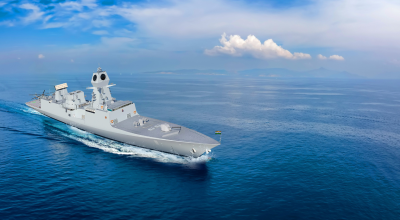
The Indian Navy inducted the stealth frigate Mahendragiri on 30 April 2026, marking the delivery of the sixth warship under the Nilgiri-class Project 17A. Built by Mazagon Dock Shipbuilders Limited (MDL) in Mumbai, the vessel represents the fourth and final Project 17A frigate constructed by this specific defense public sector shipyard. Designed indigenously by the Indian Navy’s Warship Design Bureau (WDB), the delivery highlights a compressed construction timeline, entering fleet service within 17 months of the lead class vessel. This addition directly scales up India’s maritime posture and monitoring capacity within the strategically contested corridors of the Indian Ocean Region.
Project 17A Evolution and Design Architecture
Project 17A serves as the direct technological successor to the older Project 17 Shivalik-class guided-missile frigates. It incorporates structural enhancements to balance speed, survivability, and sensory dominance.
Structural Specifications and Modular Assembly
The Nilgiri-class hulls measure 149 meters in length with a displacement profile exceeding 6,600 tonnes. The program utilized the “Integrated Construction” methodology for the first time on a major surface combatant class in India. Under this system, individual hull blocks were pre-outfitted with internal piping, electrical trunks, and auxiliary machinery prior to final structural aggregation, minimizing the overall slipway construction phase.
Signature Reduction and Stealth Features
The design minimizes the vessel’s Radar Cross Section (RCS) through specific geometric angling of the superstructure and flush deck fittings. Infrared signatures are managed through specialized engine exhaust cooling ducts. Hydrodynamic noise and acoustic profiles are suppressed via specialized hull coatings and low-cavitation propeller designs to reduce detection by enemy submarines.
Weaponry, Sensors, and Propulsion Systems
The frigates are designed as multi-domain platforms capable of simultaneously engaging threats across air, surface, and sub-surface battle spaces.
Offensive and Defensive Armaments
- Surface-to-Surface Warfare: Equipped with an 8-cell vertical launch system (VLS) handling BrahMos supersonic cruise missiles for long-range precision strikes against land and maritime targets.
- Air Defense Complex: Fitted with Vertical Launch Short Range Surface-to-Air Missile (VL-SRSAM) and Medium-Range Surface-to-Air Missile (MRSAM) systems to counter supersonic anti-ship missiles and hostile aircraft.
- Close-in Weapon Systems (CIWS): Employs a 76mm Super Rapid Gun Mount (SRGM) alongside 30mm automated guns for terminal defense.
- Anti-Submarine Warfare (ASW): Armed with indigenous heavyweight torpedo launchers and anti-submarine rocket launchers integrated with hull-mounted and towed sonar arrays.
Propulsion and Platform Control
The class runs on a Combined Diesel or Gas (CODOG) propulsion configuration. This configuration combines two General Electric LM2500 gas turbines for high-speed combat maneuvers with two MAN diesel engines for fuel-efficient, long-range cruising. Systems monitoring is handled via an Integrated Platform Management System (IPMS), which automates damage control, power distribution, and machinery health logging from a centralized station.
Indigenization and Supply Chain Integration
Project 17A achieves approximately 75% indigenous content across its structural steel, weapons, and electronics layout.
Warship Manufacturing Allotment
The Ministry of Defence divided the construction of the seven planned Nilgiri-class warships between two public sector units to balance industrial output.
| Production Shipyard | Assigned Hull Allotments | Completed / Delivered Units |
| Mazagon Dock Shipbuilders Limited (MDL) | 4 Ships | INS Nilgiri, INS Udaygiri, INS Taragiri, Mahendragiri |
| Garden Reach Shipbuilders & Engineers (GRSE) | 3 Ships | INS Himgiri, INS Dunagiri, INS Vindhyagiri |
MSME Ecosystem Impact
The indigenous supply chain ecosystem for Project 17A integrated more than 200 micro, small, and medium enterprises (MSMEs). This procurement network generated direct employment for nearly 4,000 personnel and created downstream industrial employment for over 10,000 workers across domestic manufacturing hubs.
IASPOINT Booster Facts for UPSC
- Warship Design Bureau (WDB): Formerly known as the Directorate of Naval Design (DND), this is the apex in-house agency of the Indian Navy responsible for designing all frontline warships, including the INS Vikrant aircraft carrier.
- Naming Nomenclature: The Nilgiri-class vessels are named after prominent mountain peaks in India. Mahendragiri is named after a major mountain peak located in the Gajapati district of Odisha.
- CODOG vs CODAD: Combined Diesel or Gas (CODOG) alternate between using either diesel or gas power plants depending on speed needs. Combined Diesel and Diesel (CODAD) operate both assets simultaneously to achieve maximum speeds, a configuration used in simpler logistics ships.
- Blue-Water Navy Capabilities: A blue-water navy possesses the logistical stamina, structural displacement, and force-projection assets necessary to operate globally across open oceans, distinct from a brown-water (riverine) or green-water (coastal) force.