
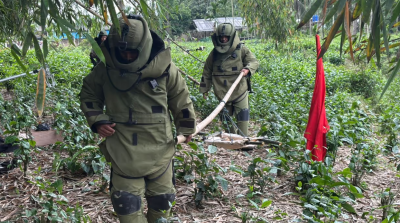
On May 1, 2026, the Indian Army defused a World War II-era unexploded shell in Singri village, located in the Ledo-Lekhapani area of Tinsukia district, Assam. The shell, measuring approximately 12 inches in length and 6 inches in diameter, was discovered during excavation work near a local shop. The Indian Army’s Red Shield Division secured the site, evacuated nearby residents, and safely neutralized the ordnance. This event is part of a series of recent discoveries in the region, including similar defusal operations on April 30, 2026, in Ledo, March 31, 2026, in Burma Camp, Lekhapani, and a 182-kilogram bomb defused by the Indian Air Force in Lakhimpur district in February 2025.
Understanding Unexploded Ordnance (UXO)
Definition and Characteristics
Unexploded Ordnance refers to explosive weapons such as bombs, shells, grenades, landmines, and cluster munitions that were deployed during armed conflicts but failed to detonate as intended. These objects remain unstable and lethally active over decades. They pose severe risks to civilian populations, infrastructure development, and agricultural activities during peace times.
Factors Causing Detonation Failure
- Mechanical Malfunctions: Faulty firing pins, defective fuses, or manufacturing anomalies in the internal detonator mechanism.
- Environmental Impact: Soft landing ground, such as mud, marshland, or deep water, which dampens the impact force required to trigger the impact fuse.
- Storage and Ageing: Chemical degradation of the explosive filling or corrosion of the outer metallic casing over time, altering the sensitivity of the fuse.
Historical Context of Assam in World War II
Strategic Importance of the Northeast
During World War II, Northeast India, particularly Assam, served as a frontline logistical and military base for the Allied Forces fighting against the Japanese Empire in the China-Burma-India (CBI) Theatre. The region housed numerous airfields, supply depots, and troop encampments.
The Ledo Road (Stilwell Road)
Constructed under the supervision of US General Joseph Stilwell, the Ledo Road started from Ledo in Tinsukia, Assam, and connected to Kunming, China, through Myanmar (Burma). It was built to bypass the Japanese blockade of the Burma Road and supply the Chinese Nationalist forces. The frequent movement of munitions, aerial bombings, and skirmishes left behind a vast footprint of buried explosive remnants.
| Key WWII Sites in Assam | Historical Role / Relevance |
| Ledo-Lekhapani (Tinsukia) | Starting point of the Stilwell Road and major Allied supply hub. |
| Digboi | Provided critical petroleum resources for Allied aircraft and vehicles. |
| Chabua / Mohanbari | Key airfields used by the US Army Air Forces for “Flying the Hump” over the Himalayas. |
Operational Protocols for UXO Disposal
Localization and Isolation
When a suspected UXO is discovered, local authorities cordon off the area to prevent civilian access. The military establishes a safety perimeter based on the estimated blast radius of the munition.
Disposal Techniques
- In-Situ Detonation: If the ordnance is too unstable or corroded to move safely, bomb disposal squads detonate it on-site using controlled explosive charges.
- Defusing and Relocation: Personnel render the fuse safe mechanically or chemically, transport the shell to a designated demolition range, and destroy it away from human habitation.
- Mitigation of Blast Effects: Sandbags, protective earthworks, or specialized blast mitigation blankets are placed around the weapon to absorb fragments and shockwaves during demolition.
IASPOINT Booster Facts for UPSC
- The Red Shield Division: Formed during World War II in 1941, this division of the Indian Army is also known as the 4th Infantry Division. It has historically operated in various theatres, including North Africa, and is currently stationed in Northeast India.
- “The Hump” Operations: This was the name given by Allied pilots to the eastern end of the Himalayan Mountains. They flew military transport aircraft over these mountains from Assam to China to deliver supplies between 1942 and 1945.
- Legal Framework for Explosives: In India, the manufacture, possession, use, sale, transport, and import of explosives are governed by the Explosives Act, 1884, and the Explosives Rules, 2008.
- International Convention: The Protocol on Explosive Remnants of War (Protocol V to the Convention on Certain Conventional Weapons) is an international treaty that requires states to assist in the clearance of unexploded and abandoned ordnance after active hostilities end.