
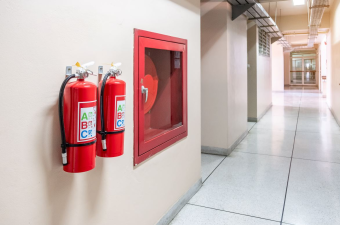
The Union Health Ministry launched Fire Safety Week from 4 May to 10 May 2026, introducing the National Guidelines on Fire and Life Safety in Healthcare Facilities for public and private hospitals. These revised guidelines mandate regular fire risk assessments, annual fire and electrical safety audits, and comprehensive fire safety plans across India. The framework addresses systemic vulnerabilities in modern healthcare facilities by enforcing digital monitoring, strict structural compliance, and specialized evacuation protocols. This national initiative aims to eliminate regulatory gaps and enhance emergency response mechanisms to prevent hospital fire tragedies.
Core Regulatory Mandates and Institutional Framework
Appointment of Dedicated Personnel
Every healthcare facility must designate a trained Fire Safety Officer. This officer is responsible for maintaining firefighting equipment, conducting daily inspections of escape routes, and ensuring zero obstructions in corridors.
Fire Safety Committees
Hospitals must establish an internal Fire Safety Committee. This committee meets quarterly to review audit reports, update emergency response maps, and coordinate directly with local municipal fire services.
Compulsory Audits and Digital Logging
The guidelines transition hospital safety from manual reporting to an online verification system.
| Audit Type | Frequency | Key Focus Areas |
| Fire Safety Audit | Annual | Functional testing of sprinklers, hydrants, smoke detectors, and fire extinguishers. |
| Electrical Safety Audit | Annual | Assessing internal wiring, circuit breakers, transformer health, and preventing electrical overloads. |
| Fire Risk Assessment | Half-Yearly | Identifying combustible material accumulation and checking emergency exit signage. |
Integrated Health Information Platform Integration
States and individual hospital administrations must upload all fire and electrical safety audit certificates onto the Integrated Health Information Platform portal. This central digital logging system ensures transparency and allows regulatory bodies to track non-compliant facilities in real time.
Zonal Risk Identification and Infrastructure Protocols
High-Risk Area Demarcation
The guidelines classify specific hospital zones as high-risk areas that require isolated fire containment systems:
- Intensive Care Units (ICUs) and Operation Theatres (OTs): High concentration of life-support machinery and localized oxygen enrichment.
- Oxygen Storage and Supply Lines: Liquid medical oxygen tanks and manifold rooms require automated shut-off valves to stop oxygen flow during a fire.
- Electrical Server Rooms and UPS Rooms: Areas prone to short circuits that require specialized gas-based (clean agent) fire suppression systems instead of water sprinklers.
Structural and Material Specifications
New and existing hospital buildings must incorporate fire-resistant materials with a minimum two-hour fire-resistance rating for stairwells and lift shafts. Fire doors must be installed to segment buildings into independent fire compartments, preventing the horizontal spread of toxic smoke.
Training, Drills, and Patient Evacuation Strategies
Compulsory Staff Training
All hospital staff, including doctors, nursing personnel, technicians, and security guards, must undergo mandatory fire safety training. Training modules cover the operation of basic fire extinguishers, patient prioritization during hazards, and the activation of manual fire alarm call points.
Mock Drills and Simulated Evacuations
Hospitals must conduct quarterly fire emergency mock drills. These drills simulate daytime and nighttime scenarios to test the response time of the internal firefighting team and the readiness of local fire departments.
Critical Care Evacuation Protocols
The guidelines introduce a specialized “Defend-in-Place” and progressive horizontal evacuation strategy for non-ambulatory and critical care patients. [Critical Patient] -> Move horizontally past Fire Doors -> Secure Compartment -> Evacuate via Fire Ramps
- Horizontal Evacuation: Moving patients on beds or stretchers horizontally through fire-rated doors into an adjacent safe compartment on the same floor, rather than immediately attempting vertical evacuation down staircases.
- Ramp Infrastructure: Every healthcare facility above a single story must possess a dedicated fire ramp with a non-slippery surface to facilitate the rapid movement of wheeled stretchers and intensive care beds.
IASPOINT Booster Facts for UPSC
- Constitutional Provision: Public health and sanitation, including hospitals and dispensaries, fall under the State List (List II) of the Seventh Schedule of the Constitution of India. Fire services also come under the domain of municipal and state authorities.
- National Building Code linkage: The new health ministry guidelines align directly with Part 4 of the National Building Code of India, which governs Fire and Life Safety requirements for institutional buildings.
- Integrated Health Information Platform: This platform is a web-enabled near-real-time electronic health information system embedded under the National Health Mission to provide a digital framework for health data, now expanded to track infrastructural safety compliance.
- Statutory Overlap: Hospitals must comply concurrently with the Petroleum and Explosives Safety Organization regulations for the storage of liquid medical oxygen cylinders and tanks.