
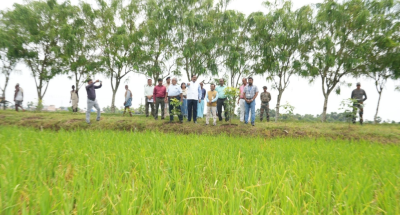
Scientists at the Bihar Agricultural University (BAU), Sabour, have developed a new drought-resistant and high-yielding paddy variety named ‘Sabour Samrat’ in 2026. Led by Dr. Prakash Singh and his research team, the variety underwent three years of rigorous multi-state trials before official recommendation. The variety addresses the challenges of water scarcity and fluctuating weather patterns in major Indian rice-growing states. By offering shorter maturity duration and lower water requirements, Sabour Samrat aims to stabilize rice productivity, reduce cultivation costs, and secure farmers’ income against climate vulnerabilities.
Key Features and Agronomic Traits
The Sabour Samrat variety possesses specific morphological and physiological traits that distinguish it from traditional rice varieties.
Crop Yield and Maturity Duration
- Maximum Yield Potential: The variety can produce up to 90 quintals per hectare under optimal management conditions. On average, it yields about 1.5 times more grain than conventional drought-prone varieties.
- Maturity Period: It matures within 115 to 120 days, placing it in the short-to-medium duration category. This allows farmers to clear fields early for subsequent rabi crop sowing.
Structural and Pest Resistance Attributes
- Plant Height and Lodging Resistance: The plant grows to a semi-dwarf height of 90 to 95 centimeters. This strong, compact structure minimizes the risk of lodging (falling over due to wind or heavy rain).
- Biotic Stress Tolerance: Multi-state trials confirmed that the variety offers high resistance to major field diseases (such as blast and bacterial leaf blight) and common insect pests.
Cultivation Methods and Resource Efficiency
Sabour Samrat is highly compatible with resource conservation technologies, making it an economically viable option for small and marginal farmers.
Direct Seeded Rice (DSR) Compatibility
- Elimination of Nursery Transplantation: The variety is suited for Direct Seeded Rice (DSR) methods. Farmers can sow seeds directly into the main field using tractor-drawn zero-till seed drills.
- Resource Savings: DSR cultivation with Sabour Samrat eliminates the need for raising nurseries, paddling fields, and manual transplanting. This reduces labor expenses, shortens crop establishment time, and saves up to 20–30% of irrigation water.
Geographical Suitability and Seed Distribution
The All India Rice Improvement Project (AIRIP) evaluated the performance of Sabour Samrat across diverse agro-climatic zones before recommending its commercial release.
Approved States for Cultivation
The variety is recommended for cultivation across eight Indian states characterized by varied rainfall and soil profiles:
- Eastern Region: Bihar, Jharkhand, and Uttar Pradesh.
- North-East Region: Assam and Tripura.
- Western and Northwestern Region: Gujarat, Haryana, and Punjab.
Seed Availability Hubs
Bihar Agricultural University is multiplying and distributing foundation seeds through its dedicated regional research stations and Krishi Vigyan Kendras (KVKs). The primary distribution hubs are located at:
- BAU Center, Rohtas
- BAU Center, Patna
Comparative Performance of Paddy Varieties
The table below compares the agronomic metrics of Sabour Samrat with typical conventional paddy varieties cultivated in identical regions.
| Agronomic Parameter | Sabour Samrat Variety | Conventional Rice Varieties |
| Average Maturity Duration | 115 – 120 Days | 140 – 150 Days |
| Average Plant Height | 90 – 95 cm (Semi-dwarf) | 110 – 130 cm (Tall) |
| Lodging Vulnerability | Very Low | Moderate to High |
| Primary Sowing Suitability | Direct Seeded Rice (DSR) & Transplanting | Predominantly Manual Transplanting |
| Drought Tolerance Level | High (Maintains yield under moisture stress) | Low to Moderate |
IASPOINT Booster Facts for UPSC
- Bihar Agricultural University (BAU): Established in August 2010, BAU is an autonomous institution located at Sabour, Bhagalpur district, Bihar.
- All India Rice Improvement Project (AIRIP): Established by the Indian Council of Agricultural Research (ICAR) in 1965 to coordinate multi-location testing of rice varieties across India.
- Direct Seeded Rice (DSR) Mechanism: Unlike traditional transplanting which requires continuous land submergence under 3-5 cm of water, DSR requires water only for soil moistening, drastically reducing methane emissions from stagnant water.
- Lodging Definition: The permanent displacement of crop stems from their upright position, caused by heavy winds, excessive nitrogen fertilizers, or weak stem structure, which disrupts mechanical harvesting and reduces grain quality.