
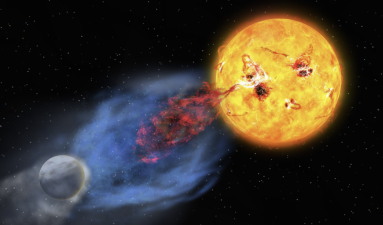
Scientists have advanced understanding of coronal mass ejections (CMEs), the explosive eruptions from the Sun that can trigger geomagnetic storms, disrupt satellites and power grids, and endanger astronauts. A new study using magnetohydrodynamic simulations has identified two key factors that influence whether a solar eruption succeeds or fails – the strength of the Sun’s global magnetic field and the rate at which magnetic twist builds up in the corona.
Core Finding on CME Trigger
The study used the breakout model, a leading theory for CME initiation. It showed that the Sun’s large-scale magnetic field acts like a magnetic cage. When this background field is strong, it restrains the eruption and makes escape difficult. When the field is weaker, the eruption can break out more easily.
Relevance to Solar Cycle 24
The findings help explain a solar puzzle linked to Solar Cycle 24. Although that cycle was magnetically weaker than Solar Cycle 23, it produced a relatively high number of CMEs. The simulations suggest that the weaker background magnetic field lowered the threshold for eruption, allowing even smaller events to escape into space.
Absolute Net Current Helicity as Indicator
The study also examined magnetic twist, or helicity, in the solar corona. Researchers found that the rate of increase in Absolute Net Current Helicity (ANCH) was more important than its total amount. A slow rise in ANCH was associated with failed eruptions, where the magnetic structure formed but fell back. A rapid rise consistently preceded successful CMEs. In some cases, the fastest injection produced multiple eruptions from the same region.
Significance for Space Weather Forecasting
The results suggest that ANCH growth rate may become a useful forecasting parameter for distinguishing between failed, single, and multiple eruption scenarios. This could improve space weather prediction and help protect critical infrastructure from solar storm impacts. The study also strengthens the value of numerical simulations as a virtual laboratory for testing solar eruption physics.
Last Modified: April 28, 2026