
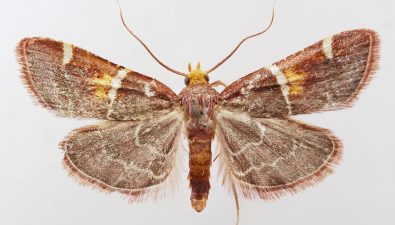
Entomologists formally described a new moth species, Pyralis papaleonei, in the peer-reviewed scientific journal Nota Lepidopterologica. Discovered in the high-altitude habitats of western Crete, Greece, this insect is a regional endemic restricted entirely to the island. The research and subsequent classification were spearheaded by an international team of scientists representing academic institutions in Austria, Finland, and Germany. The species stands out due to its unique genetic divergence and its vibrant wing patterns. The discovery underscores that even heavily studied European ecosystems continue to harbor undocumented macro-organism biodiversity.
Taxonomy and Nomenclature
Familial Classification
Pyralis papaleonei belongs to the genus Pyralis within the family Pyralidae, which sits inside the massive superfamily Pyraloidea. The Pyralidae family consists of moths characterized by specialized hearing organs or tympanal cavities located on the abdomen, along with a scaled proboscis.
Etymology and Naming Tradition
The species is colloquially nicknamed the “Pope Leo moth.” The specific epithet papaleonei is derived from the Italian phrase “Papa Leone,” honoring Pope Leo Fourteenth, who was elected to the papacy. Entomologists selected this name to acknowledge the pontiff’s public advocacy for global environmental conservation and climate protection. This nomenclature aligns with a historic 250-year-old tradition within the genus Pyralis of assigning regal or high-office titles to visually striking specimens.
Morphological Features and Structural Identification
Wing Architecture and Coloration
The moth is a medium-sized micro-lepidopteran with an adult wingspan measuring approximately two centimeters (around 0.75 inches). The forewings display a deep purple background color, accented by deep orange-gold patches and precise white bands. A narrow, uniformly slender white median band runs entirely across each forewing, serving as a primary visual marker that separates it from close relatives. Its hindwings are a pale grayish-purple hue, systematically divided into three distinct segments by two jagged white lines showing minimal color contrast.
Genital Morphology
Definitive taxonomic differentiation from sister taxa relied on examining internal reproductive anatomy. In female specimens of Pyralis papaleonei, structural identification revealed a specialized, hardened internal plate known as a sclerotized signum within the bursa copulatrix. This diagnostic feature is completely missing in other closely related members of the Pyralis regalis species complex. Male specimens similarly display a distinct combination of valvae and aedeagus structures unique to this lineage.
Genetic Profiling and Evolutionary Divergence
DNA Barcoding Protocols
To validate the morphological findings, scientists extracted and analyzed mitochondrial DNA sequences. The molecular profiling targeted the cytochrome c oxidase subunit 1 (COI) gene, which serves as the universal standard barcode for animal life. The testing incorporated 38 new tissue samples compared against a regional database containing 90 previously established Pyralidae sequences.
Divergence Percentages
The genetic results confirmed that the Cretan population constitutes an isolated evolutionary branch. Molecular data indicated a 5.78 percent genetic divergence from its closest relative, Pyralis kacheticalis. It also showed a 9.4 percent genetic divergence from Pyralis regalis, a distinct species inhabiting the nearby Peloponnese peninsula of mainland Greece. These percentages sit well above the standard threshold required to establish a standalone species in insect taxonomy.
Habitat, Distribution, and Behavior
Geographic Boundaries
The known distribution of Pyralis papaleonei is exclusively localized to the Lefka Ori, also known as the White Mountains, situated in western Crete. Most specimens were collected within the high-altitude terrains of the Omalos plateau, at elevations ranging between 1,000 and 1,200 meters above mean sea level.
Behavioral Phenology
Adult moths exhibit nocturnal behavior and are highly attracted to artificial ultraviolet and incandescent light sources, which facilitated their capture by researchers. Field data indicates that peak adult flight activity occurs during the month of June. A single specimen collected in October suggests the possibility of an extended flight season or the production of a partial second generation within a single calendar year. The early life stages, larval morphology, and specific larval host plants remain entirely unknown to science.
Comparative Matrix of the Genus Pyralis
| Species Name | Secular / Ecclesiastical Title Meaning | Geographic Distribution | Key Distinguishing Visual Feature |
| Pyralis papaleonei | Pope Leo XIV | White Mountains, Crete (Endemic) | Uniformly narrow white forewing band; grayish-purple hindwings. |
| Pyralis regalis | Royal / King | Mainland Europe and Peloponnese | Broad, highly contrasting white wing bands with brilliant orange markings. |
| Pyralis kacheticalis | Regional Toponym (Kakheti) | Eastern Mediterranean, Iraq, Armenia | Broader white bands; lacks the specific female sclerotized signum. |
| Pyralis cardinalis | Cardinal | Southern / Eastern Europe | Deep crimson-tinted borders flanking the primary wing bands. |
| Pyralis princeps | Prince | Central and Eastern Europe | Enlarged golden-orange patches with undulating white lines. |
IASPOINT Booster Facts for UPSC
Endemism in Crete
Due to its long-term geographic isolation from mainland Europe and Africa, the island of Crete is an evolutionary hotspot. Approximately 40 percent of the island’s 76 currently known endemic insect species have been discovered and described since the year 2000, illustrating the high density of micro-refugia in its mountain ranges.
Superfamily Pyraloidea
Commonly called snout moths due to the elongated labial palps found on many species, this group is one of the largest lepidopteran lineages. It contains more than 16,000 described species globally. Several members are economically vital as agricultural pests affecting stored grains, timber, and crops.
International Journal: Nota Lepidopterologica
This is a peer-reviewed, open-access scientific journal published by Pensoft Publishers on behalf of the Societas Europaea Lepidopterologica (SEL). It focuses exclusively on the study of butterflies and moths, covering taxonomy, systematics, biogeography, and conservation biology.
Biodiversity Hotspots Concept
To qualify as a global biodiversity hotspot under the criteria established by Conservation International, a region must meet two strict conditions: it must contain at least 1,500 species of vascular plants as endemics (more than 0.5 percent of the world’s total), and it must have lost at least 70 percent of its original native primary vegetation. The Mediterranean basin, which includes Crete, is recognized as one of these critical global conservation zones.
Museum Research Collaborations
The specimens of the new moth were analyzed through the joint efforts of three major European research bodies: the Natural History Collections of the Tiroler Landesmuseen in Innsbruck (Austria), the Finnish Museum of Natural History at the University of Helsinki (Finland), and the SNSB-Zoologische Staatssammlung München (Germany).
Last Modified: May 19, 2026