
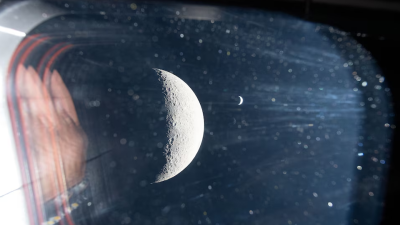
NASA released 12,217 high-resolution images from the Artemis II mission, which launched on 1 April 2026 and concluded with a successful splashdown in the Pacific Ocean near San Diego on 10 April 2026. Artemis II marked the first crewed lunar flyby mission under the Artemis programme, utilizing the Orion spacecraft named Integrity. The crew consisted of four astronauts, including three from NASA and one from the Canadian Space Agency. This mission represented the first crewed flight beyond low Earth orbit in over 50 years, setting a human deep-space distance record of approximately 406,773 kilometers from Earth.
Mission Profile and Photography Logistics
The Artemis II mission combined high-velocity orbital mechanics with advanced consumer and industrial imaging hardware to document deep space environments.
Hardware and Imaging Technology
- Camera Equipment: The crew used modified Nikon DSLR and mirrorless cameras equipped with radiation-shielded sensors alongside commercial iPhone 17 devices to capture ambient cabin data and rapid-fire external shots.
- Data Recovery: Because of bandwidth limitations on deep-space radio links, technicians recovered the bulk of the 12,217 images directly from physical solid-state storage drives inside the Orion capsule after splashdown.
- Release Timeline: NASA published the dataset in structured stages through its digital archives, cataloging the images by mission elapsed time (MET) and subject category.
Core Visual Subjects Captured
- The Lunar Far Side: Detailed close-up photographs of the cratered terrain on the Moon’s permanently hidden hemisphere.
- The Earthset Phenomenon: Visual sequences showing the Earth dipping below the curved horizon of the Moon.
- Total Solar Eclipse: High-contrast images of the 8 April 2026 total solar eclipse, taken from a unique spatial vantage point outside Earth’s atmosphere.
Mission Specifications and Flight Architecture
The ten-day flight tested the core components of NASA’s deep-space transportation network under human operational conditions.
| Mission Parameter | Technical Details |
| Launch Vehicle | Space Launch System (SLS) Block 1 |
| Spacecraft Designation | Orion Capsule Integrity |
| Launch Date | 1 April 2026 |
| Splashdown Date | 10 April 2026 |
| Landing Zone | Pacific Ocean, off the coast of San Diego, California |
| Maximum Distance from Earth | ~406,773 kilometers (252,757 miles) |
| Mission Duration | 9 days, 3 hours, 21 minutes |
Crew Composition
The four-member crew tested the Orion environmental control and life support systems (ECLSS) during the lunar flyby:
- Reid Wiseman (NASA): Commander
- Victor Glover (NASA): Pilot
- Christina Koch (NASA): Mission Specialist
- Jeremy Hansen (CSA): Mission Specialist (Canadian Space Agency)
Trajectory and Flight Phases
The Artemis II flight path utilized a hybrid trajectory profile to maximize safety and return options.
High Earth Orbit (HEO) Phase
After launch, the SLS upper stage placed Orion into a high Earth orbit with a period of 42 hours. This phase allowed the crew to test the spacecraft’s life support systems close to Earth before committing to the lunar flyby.
Trans-Lunar Injection (TLI)
The spacecraft executed a TLI burn to enter a free-return trajectory. This path used lunar gravity to swing the spacecraft around the far side of the Moon and pull it back to Earth naturally without requiring a major propulsion burn to return.
IASPOINT Booster Facts for UPSC
- Free-Return Trajectory: A spacecraft trajectory where gravity from a secondary body (the Moon) alters the flight path enough to return the spacecraft to its starting point (Earth) without using additional fuel.
- Van Allen Radiation Belts: Orion passed through these high-radiation zones twice during the HEO phase, verifying the radiation shielding efficiency of the spacecraft’s hull and crew quarters.
- Firsts in Deep Space: Victor Glover became the first person of color, Christina Koch the first woman, and Jeremy Hansen the first non-American to travel beyond low Earth orbit.
- Deep Space Network (DSN): NASA used its global antenna network in Goldstone (USA), Madrid (Spain), and Canberra (Australia) to track Orion and download the initial preview images.
- Space Launch System (SLS): The most powerful operational rocket ever built by NASA, generating 8.8 million pounds of maximum thrust during liftoff, which is 15% more thrust than the Apollo-era Saturn V rocket.