
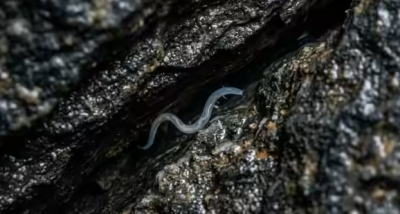
Researchers discovered Plutomurus ortobalaganensis, a specialized species of springtail, during the Ibero-Russian CaveX expedition in 2010. Found at a depth of 1,980 meters within the Krubera-Voronja cave system in Abkhazia, near the Black Sea, it holds the record as the world’s deepest terrestrial animal. This wingless and eyeless arthropod thrives in absolute darkness and near-freezing temperatures, subsisting entirely on fungi and decomposing organic material. The discovery expands scientific understanding of subterranean ecosystems and demonstrates the capacity of highly adapted multicellular life to survive under extreme subterranean pressures.
Biological Profile and Morphological Adaptations
Plutomurus ortobalaganensis belongs to the class Collembola, commonly known as springtails. Evolution in a continuous sub-surface environment has shaped its distinct physical characteristics.
Morphological Specializations
- Loss of Vision: The species is completely eyeless. Because it lives in permanent darkness, it does not require visual organs, saving metabolic energy.
- Pigmentation Loss: It lacks body pigmentation, appearing translucent or whitish. Melanin production is unnecessary without exposure to ultraviolet radiation.
- Chemosensory Enhancement: To navigate and locate food, the insect relies on highly developed chemical and tactile receptors on its long antennae and body.
- The Furcula: Like other springtails, it possesses a tail-like appendage called a furcula folded under the abdomen. When threatened, the furcula releases to propel the insect away from predators.
Habitat and Environmental Conditions
The species lives in constant ambient temperatures ranging between 0.5°C and 5°C. It occupies the deep troglobitic zone, where food resources are scarce. The species survives by consuming fungal hyphae, bacterial biofilms, and detritus draining from the surface.
The Krubera-Voronja Cave System
Located in the Arabika Massif of the Gagra Range in Abkhazia, Georgia, the Krubera-Voronja cave system is one of the deepest known caves on Earth.
Geological and Ecological Framework
The cave is a deep karst formation created by the dissolution of soluble rocks like limestone. The 2010 Ibero-Russian CaveX team explored its vertical shafts and subterranean chambers to document life at varying depths.
Co-Existing Subterranean Species
The expedition identified a stratified community of four distinct springtail species living at different depths within the same cave system:
| Species Name | Discovery Depth | Zone Category |
| Anurida stereoodorata | 100 meters | Near-surface cave zone |
| Deuteraphorura kruberaensis | 550 meters | Shallow troglobitic zone |
| Schaefferia profundissima | 1,600 meters | Deep troglobitic zone |
| Plutomurus ortobalaganensis | 1,980 meters | Extreme deep troglobitic zone |
Subterranean Life and Extreme Nematodes
The discovery of deep-dwelling arthropods matches similar findings of multicellular organisms deep within the Earth’s crust, such as deep-mine nematodes.
Halicephalobus mephisto
While Plutomurus ortobalaganensis is the deepest land arthropod, the nematode Halicephalobus mephisto holds the record for the deepest multicellular organism found underground. Discovered in 2011 inside the Beatrix Gold Mine in South Africa, this nematode thrives 1.3 kilometers below the surface.
Comparative Survival Mechanisms
Unlike the cold-adapted springtail, Halicephalobus mephisto survives in fluid pockets with temperatures reaching 37°C, high hydrostatic pressures, and critically low oxygen levels. Genetic sequencing reveals that the nematode has duplicated its Hsp70 gene copies. This adaptation allows it to produce high levels of heat shock proteins to repair cellular damage caused by extreme thermal stress. Both organisms utilize a diet of subterranean bacteria to survive independently of solar energy.
IASPOINT Booster Facts for UPSC
- Troglobites: These are obligate cave-dwelling organisms completely adapted to subterranean environments. They cannot survive outside of cave systems due to their sensitivity to light, desiccation, and temperature fluctuations.
- Collembola Classification: Springtails are no longer classified as true insects. They are categorized as hexapods belonging to an independent, primitive lineage called entognathous arthropods because their mouthparts are retracted inside the head capsule.
- Karst Topography: This geological landscape forms from the dissolution of soluble rocks such as limestone, dolomite, and gypsum. It is characterized by sinkholes, losing streams, springs, and extensive underground cave networks like the Arabika Massif.
- Anhydrobiosis: Many deep-subterranean microorganisms and nematodes like Halicephalobus mephisto can undergo anhydrobiosis. This metabolic state allows them to survive near-total dehydration and dormancy for long periods until moisture returns.
- Chemoautotrophy Support: In deep cave systems devoid of sunlight, food chains often rely on chemoautotrophic bacteria. These bacteria fix carbon by oxidizing inorganic chemicals like sulfur, iron, or methane, forming the primary energy base for deep troglobitic communities.