
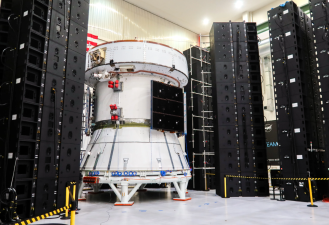
NASA has redefined Artemis III as a crewed low Earth orbit mission scheduled for late 2027 to evaluate rendezvous and docking systems with commercial human landing systems. The mission profile departs from the initial plan of a crewed lunar landing, shifting the lunar descent milestone to Artemis IV in 2028. The mission focuses on evaluating the technical and operational integration of the Orion spacecraft with commercial landers in a 460-kilometer orbit. This orbital configuration allows flexible launch windows and real-time troubleshooting, serving as a critical risk-mitigation stage before long-duration deep space transits.
Mission Architecture and Launch Vehicle Modifications
The baseline flight configuration involves modifications to the traditional Space Launch System stack to suit an orbital demonstration.
Non-Propulsive Spacer Integration
Unlike previous iterations, the Artemis III Space Launch System rocket will fly without a propulsive Interim Cryogenic Propulsion Stage. NASA is substituting this upper stage with a structural, non-propulsive spacer fabricated at the Marshall Space Flight Center. This component matches the physical mass, dimensions, and structural interface connection points of the standard upper stage. This engineering choice preserves the remaining upper stage inventory for high-energy lunar trajectories during Artemis IV.
Orbital Insertion Mechanics
The Space Launch System core booster will deploy the Orion spacecraft directly into an initial trajectory. The European Service Module will then execute a prolonged engine burn to circularize Orion into low Earth orbit. The European Service Module remains responsible for orbital maneuvering, life support distribution, and the critical de-orbit burn at mission completion.
Rendezvous, Proximity Operations, and Docking Framework
The primary technical objective centers on verifying the mechanical, electrical, and data-linked performance of the docking systems between distinct space vehicles.
Multi-Vehicle Integration Campaign
The four-person crew will manage a complex proximity flight profile to execute docking maneuvers with two separately launched commercial pathfinder landers. This marks the first time NASA will actively integrate hardware from its competing commercial lander developers simultaneously during a single flight campaign.
SpaceX Starship Human Landing System Pathfinder
Astronauts will interface with a prototype variant of the Starship human landing system. The operations will test deep-space proximity telemetry, laser-radar automated tracking systems, and automated station-keeping algorithms under real flight dynamics.
Blue Origin Blue Moon Mark 2 Pathfinder
The mission will test the structural and electrical docking mechanisms of Blue Origin’s Blue Moon Mark 2 lander platform. The test ensures that physical connection ports can handle heavy crew-transfer loads and cross-vehicle power distribution without mechanical binding.
Life Support, Habitation, and EVA Evaluation
The flight extends the operational timeline for astronauts inside the capsule to gather data on environmental control systems.
Extended Habitation Trials
The crew will spend approximately 10 days aboard the Orion spacecraft. This duration allows engineers to gather exhaustive performance data on the closed-loop Environmental Control and Life Support System, monitoring air filtration, humidity extraction, and waste management systems over extended durations.
Intra-Vehicular Lander Transfers
Preliminary flight concepts state that the crew will open the docking hatches and enter at least one of the commercial lander test cabins. This action verifies structural airlock integrity, internal pressure stabilization, and crew communication protocols between the distinct operating systems of Orion and the commercial modules.
AxEMU Spacesuit Interface Verification
NASA intends to utilize the orbital trial to evaluate the Axiom Extravehicular Mobility Unit spacesuits developed by Axiom Space. The testing focuses on how the spacesuit interfaces with the lander cabins, storage modules, and physical display terminals, validating human factors and internal mobility parameters before surface deployment.
Reentry Dynamics and Thermal Protection System Upgrade
The conclusion of the mission focuses on testing materials to ensure the capsule can survive high-energy atmospheric reentries.
Upgraded Ablative Heat Shield Block
Artemis III will mark the operational debut of an redesigned ablative heat shield block configuration on the Orion capsule. This material redesign fixes localized surface erosion anomalies discovered after the uncrewed Artemis I flight in 2022.
Validation of Skip Reentry Profiles
Testing the modified thermal layer during a high-speed entry from low Earth orbit allows engineers to measure structural degradation data. This validation is critical for confirming steep skip-reentry profiles, where the spacecraft bounces off the upper layers of the atmosphere to bleed off extreme velocity before final parachute deployment.
Core Technological Parameters of Artemis Flight Vehicles
| Vehicle Component | Prime Developer | Primary Mission Role | Core Technological Feature |
| Orion Capsule | Lockheed Martin | Crew transportation and atmospheric reentry | Upgraded ablative heat shield and digital docking interface |
| European Service Module | Airbus / ESA | Propulsion, power generation, and life support | Four-tank propellant system and solar array wings |
| Starship HLS | SpaceX | High-capacity lunar landing pathfinder | Methane-fueled Raptor engines and autonomous docking array |
| Blue Moon Mark 2 | Blue Origin | Precision lunar landing pathfinder | Hydrogen-fueled BE-7 engine and automated proximity sensors |
| AxEMU Spacesuit | Axiom Space | Extravehicular surface and cabin operations | Anthropomorphic joints and integrated communication electronics |
IASPOINT Booster Facts for UPSC
- Apollo 9 Analog: The restructured Artemis III mission profile is direct parallel to the 1969 Apollo 9 mission, which remained in Earth orbit to test the lunar module docking mechanisms before the actual Apollo 11 moon landing.
- Michoud Assembly Facility: Located in New Orleans, this specialized facility is where Boeing finalized the liquid hydrogen and liquid oxygen core stage tanks for the Artemis III launch vehicle.
- RS-25 Engines: The Space Launch System core stage utilizes four RS-25 engines, which are upgraded, refurbished variants of the Space Shuttle Main Engines.
- Deep Space Network Exclusion: Because Artemis III remains in low Earth orbit, it will bypass the Deep Space Network, relying instead on near-Earth commercial space communication architectures and tracking networks.
- CubeSat Deployment Opportunities: NASA has opened secondary payload slots on the Space Launch System stage adapter, soliciting domestic and international proposals to deploy scientific CubeSats directly into low Earth orbit.