
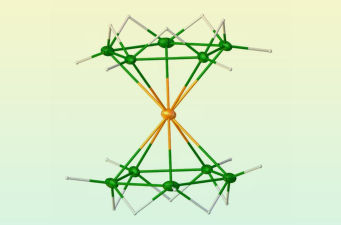
Researchers from the Indian Institute of Technology (IIT) Madras and the Indian Institute of Science (IISc) Bengaluru have synthesized a novel carbon-free molecule that replicates the classic “sandwich” structure of ferrocene. This achievement, published in the journal Science, solves a theoretical puzzle that had eluded global scientists for more than 70 years. Led by Prof. Sundargopal Ghosh and Stutee Mohapatra from IIT Madras, alongside Prof. Eluvathingal D. Jemmis from IISc Bengaluru, the team developed a stable molecular analogue that entirely replaces carbon-based rings with boron. This fundamental shift challenges long-held principles regarding the uniqueness of carbon in sandwich-shaped chemical architectures.
Decoupling the Sandwich Complex Architecture
The Classical Ferrocene Standard
Discovered in the early 1950s, ferrocene ([C10H10Fe]) established the field of organometallic chemistry. Its structural geometry features a single iron (Fe) atom held between two parallel, flat cyclopentadienyl carbon rings. The structural stability of this configuration relies on covalent sharing between the transition metal and the electron-dense carbon formations. Ferrocene is widely used in modern industry, functioning as an essential component in specialized medicines, battery packs, microelectronics, and industrial catalysts.
The Carbon-Free Innovation
The newly synthesized compound ([Os(η5-B5H10)2]) eliminates both iron and carbon from the core design. Researchers used computational modeling to identify alternative elements capable of maintaining structural equilibrium without carbon. The resulting molecule contains:
- A single central Osmium (Os) transition metal atom.
- Two parallel, flat boron-based rings (B5H10) acting as the outer layers.
- An arrangement where the osmium atom is fixed symmetrically between the twin boron rings.
Molecular Geometry and Chemical Bonding Dynamics
Bond Strength and Distance Metrics
X-ray diffraction and nuclear magnetic resonance (NMR) spectroscopy confirmed that the metal-ring bonds in the osmium-boron compound are stronger than those in classical carbon-based ferrocene. This increased strength is driven by orbital rehybridization caused by bridging hydrogen bonds within the system. The compound displays a ring-to-ring separation distance of 3.071 angstroms, arranging itself naturally into a staggered molecular conformation.
Structural Variations
During the crystallization process, the research team isolated an alternative spatial structure known as an isomer: [Os(η5-B5H10)(η3-B5H10)]. This specific version features a non-traditional coordination mode where one of the boron rings connects to the central metal differently. This variant demonstrates that boron-based rings can bind with transition metals using multiple configurations not found in carbon-based analogues.
Strategic Material Science Implications
Developing Next-Generation Catalysts
The chemical stability and strong bonding observed in the osmium-boron compound indicate it can withstand extreme environmental conditions. This durability makes it a candidate for developing industrial catalysts designed to operate at high temperatures.
Advancing Two-Dimensional Boron Chemistry
This research supports the development of two-dimensional boron chemistry, specifically matching the properties of material layers like borophenes. The ability to place metal atoms between stable inorganic sheets provides a path to engineer new materials that could rival graphene in electrical conductivity and mechanical strength.
IASPOINT Booster Facts for UPSC
- Organometallic Chemistry Frontier: Organometallic compounds are chemical entities defined by at least one direct bond between a carbon atom of an organic molecule and a metal. The new Indian discovery expands this discipline into purely inorganic sandwich complexes.
- The Periodic Table Context: Boron sits directly adjacent to carbon on the periodic table. While it can replicate similar ring-shaped structures, its electron-deficient nature typically causes it to form three-dimensional clusters rather than flat rings.
- Reagent Components: The successful synthesis was achieved by reacting a polymeric osmium-bromine precursor ([(COD)OsBr2]x) with a monoborane source (borane-dimethyl sulfide) under controlled thermal conditions at 100°C.
- Valence Electron Count: The stable osmium-boron complex preserves an 18-electron configuration around the central osmium atom, matching the chemical stability rules seen in classical ferrocene complexes.
- Sovereign Research Funding: This breakthrough was supported by national scientific grants, including funding through the National Science Chair program under the Anusandhan National Research Foundation (ANRF).