
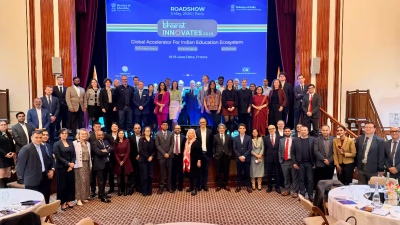
The Ministry of Education organized a promotional pre-event roadshow in Paris on 5 May 2026 for the upcoming Bharat Innovates 2026 summit. Scheduled to take place from 14 to 16 June 2026 at the Palais des Expositions in Nice, France, this summit aims to connect Indian deep-technology startups with global venture capitalists, multinational corporations, universities, and research facilities. The event seeks to secure cross-border investments, commercial pilots, market access, and collaborative research and development opportunities. Announcing this initiative on 17 February during the India-France Year of Innovation, Prime Minister Narendra Modi positioned it as a step toward internationalizing India’s high-technology ecosystem.
Event Framework and Institutional Participation
The promotional roadshow in Paris drew over 50 prominent institutional leaders to coordinate global market integration for Indian deep-tech enterprises.
Participating Entities and Stakeholders
- Government Bodies: Representatives from the Ministry of Education and officials from the Embassy of India in Paris led the strategic briefings.
- Industry Delegations: The Confederation of Indian Industry (CII) managed business-to-business networking agendas.
- French Innovation Ecosystem: Executive representatives from La French Tech and VivaTech joined to facilitate access to European incubator networks.
Selection and Mentorship Pipeline
- Initial Cohort: Over 200 deep-tech startups were initially shortlisted based on intellectual property ownership, technological readiness levels, and scalability.
- Final Selection: A final cohort of 100 to 120 startups will be determined following a final screening and evaluation pitch event hosted at the Indian Institute of Technology (IIT) Bombay.
Focus Sectors of Bharat Innovates 2026
The summit targets 13 frontier technology domains that demand high capital investment, extensive research cycles, and proprietary scientific breakthroughs.
Primary Technology Segments
| Technology Sector | Core Focus Areas |
| Advanced Computing | Quantum computing architectures, exascale processing systems, and edge AI algorithms. |
| Semiconductors | Integrated circuit design, compound semiconductor fabrication, and advanced packaging solutions. |
| Next-Generation Communications | 6G wireless network standards, satellite-based broadband, and software-defined networking. |
| Biotechnology | Synthetic biology, CRISPR gene editing, personalized therapeutics, and bioinformatics. |
| Space and Defence | Low-Earth orbit small satellite constellations, geospatial analytics, and autonomous defense systems. |
| Advanced Materials | Graphene applications, metamaterials, self-healing polymers, and high-performance alloys. |
National Deep-Tech Policy Landscape
India is establishing institutional frameworks to nurture deep-tech enterprises through funding, intellectual property protection, and infrastructure support.
National Deep Tech Startup Policy (NDTSP)
The draft NDTSP outlines specific measures to sustain high-risk scientific ventures during their prolonged gestation periods.
- Open Access to Research: Creates pathways for startups to utilize state-funded laboratories, supercomputing facilities, and academic testing beds.
- Long-Term Capital Pools: Proposes dedicated “Fund of Funds” structures to mitigate the lack of early-stage venture capital for hardware-intensive innovations.
- Intellectual Property Protection: Streamlines patent examination processes for deep-tech entities through the Patent Facilitation Programme.
Bilateral Science and Technology Collaborations
The India-France Year of Innovation serves as a diplomatic umbrella to expand technical exchange. Collaborative frameworks between the Department of Science and Technology (DST) and France’s National Centre for Scientific Research (CNRS) focus on joint supercomputing applications, clean energy storage, and marine biotechnology projects.
IASPOINT Booster Facts for UPSC
- Deep-Tech Definition: Deep technology refers to startups founded on tangible scientific discoveries or engineering innovations. Unlike shallow-tech ventures that focus on business model innovation or app development, deep-tech involves high technical risk and requires substantial research and development before commercialization.
- Technology Readiness Levels (TRL): A measurement system developed by NASA to assess the maturity level of a particular technology. It ranges from TRL 1 (basic principles observed) to TRL 9 (actual system proven through successful mission operations). Deep-tech policies focus on bridging the gap between TRL 4 (laboratory validation) and TRL 7 (operational demonstration).
- Anusandhan National Research Foundation (NRF): Established under the NRF Act 2023, this body seeds, grows, and promotes research and development across India’s universities and colleges. It provides institutional funding that feeds into the national deep-tech pipeline.
- VivaTech: This is Europe’s largest annual technology and startup event, held annually in Paris. The participation of VivaTech operators in the Bharat Innovates roadshow gives Indian startups direct entry points into European venture networks.
- La French Tech: A French government-backed movement that brings together French startups, investors, policymakers, and community builders to promote France as an international hub for tech innovation.