
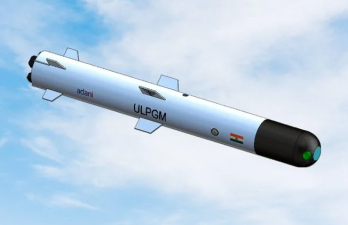
The Defence Research & Development Organisation (DRDO) completed the final configuration development trials of the Unmanned Aerial Vehicle Launched Precision Guided Missile (ULPGM)-V3 on May 19, 2026. Conducted at the National Open Area Range near Kurnool, Andhra Pradesh, the tests validated the weapon system in both Air-to-Ground and Air-to-Air combat modes. Launched from an indigenous unmanned aerial platform, the missile successfully engaged simulated ground armor and airborne threats. This milestone transitions the weapon system from the developmental phase to readiness for serial mass production and induction into the Indian Armed Forces.
Technical Profiles and Design Parameters
Guidance and Seeker Architecture
The ULPGM-V3, also designated as the UAV Launched Missile-Extended Range (ULM-ER), is an autonomous, fire-and-forget weapon system. For terminal guidance, the missile utilizes a high-definition dual-channel Imaging Infrared (IIR) seeker alongside passive homing capabilities, enabling operations during day and night across diverse terrain profiles. A integrated two-way data link facilitates real-time post-launch target updates, mid-course flight corrections, and re-targeting commands from the control station.
Propulsion and Physical Dimensions
The missile weighs 12.5 kilograms and is propelled by a solid-fuel, dual-thrust rocket motor that uses smokeless propellant to minimize visual and thermal signatures during flight. It achieves a maximum stand-off range of 10 kilometers. This extended range allows parent unmanned platforms to deploy the weapon outside the effective envelope of short-range enemy air defense systems.
Modular Warhead Configurations
The missile incorporates a modular payload section to address diverse tactical threats. It can be configured with three distinct warhead options:
- Tandem Shaped-Charge Warhead: Engineered for top-attack profiles to defeat heavy armor equipped with Explosive Reactive Armour (ERA).
- Penetration-Cum-Blast (PCB) Payload: Designed for structural degradation and bunker-busting operations.
- Pre-Fragmentation Warhead: Optimized for soft-skinned vehicles, defensive positions, and low-speed aerial targets.
System Integration and Operational Infrastructure
Ground Control System Capabilities
The weapon system functions in coordination with an integrated Ground Control System (GCS). The advanced software architecture within the GCS automates missile pre-flight health checks, parameter initialization, and launch readiness sequences. This automation reduces human operator workload during critical combat phases and streamlines engagement timelines.
Launch Platforms and Aerial Integration
For the final developmental trials, the ULPGM-V3 was integrated onto unmanned aerial vehicles designed by Newspace Research and Technologies, a Bengaluru-based private defence firm. The lightweight construction of the missile ensures structural compatibility across a wide range of platforms, varying from tactical multirotor hexacopters used by infantry units to high-endurance fixed-wing surveillance drones.
Industrial Manufacturing Ecosystem
Public-Private Development Framework
The development of the ULPGM-V3 reflects an execution model combining state research labs with private production agencies under the Development-cum-Production Partner (DcPP) program. Research Centre Imarat (RCI), Hyderabad, served as the nodal design laboratory.
Production Partners and Supply Chain
Manufacturing and serial production responsibilities are divided between public sector undertakings and private defense entities to secure parallel supply chains:
- Bharat Dynamics Limited (BDL): Based in Hyderabad, leading the public sector production line.
- Adani Defence Systems & Technologies Limited: Providing scalable private sector manufacturing facilities.
- Micro, Small, and Medium Enterprises (MSMEs): A network of domestic MSMEs handles component fabrication, sub-system wiring, and structural casting, establishing a fully mature domestic supply chain.
Comparative Overview of ULPGM Versions
| Metric / Feature | ULPGM-V1 | ULPGM-V2 | ULPGM-V3 (ULM-ER) |
| Total Weight | 5 kilograms | 8.5 kilograms | 12.5 kilograms |
| Maximum Range | 2 kilometers | 4 kilometers | 10 kilometers |
| Guidance System | Imaging Infrared (IIR) | Mid-course Update + EO | Two-way Datalink + Dual-Channel IIR |
| Primary Targets | Soft-skinned vehicles | Light fortifications | Heavy armor and airborne threats |
| Primary Warhead | Pre-fragmented | High-Explosive Anti-Tank | Tandem-charge / Penetration-cum-blast |
IASPOINT Booster Facts for UPSC
- Nodal Design Laboratory: Research Centre Imarat (RCI), Hyderabad, is a premier DRDO laboratory conceptualized by Dr. APJ Abdul Kalam, specializing in satellite navigation, control systems, and guided missile telemetry.
- Collaborating DRDO Labs: The missile development team includes the Defence Research and Development Laboratory (DRDL), Hyderabad (propulsion); the Terminal Ballistics Research Laboratory (TBRL), Chandigarh (warhead lethality); and the High Energy Materials Research Laboratory (HEMRL), Pune (propellant formulation).
- Top-Attack Mode Capability: In anti-tank operations, the ULPGM-V3 climbs sharply post-launch and strikes armored vehicles from above. This targets the turret roof, which carries the thinnest armor protection on a main battle tank.
- Strategic Dual-Role Versatility: The capability to neutralize both ground tanks (Air-to-Ground) and aerial drones or helicopters (Air-to-Air) using a single, uniform missile chassis is a feature shared by very few low-weight drone munitions globally.
- National Open Area Range (NOAR): Located in Kurnool, Andhra Pradesh, NOAR provides the specialized, unpopulated airspace and tracking telemetry infrastructure needed to safely test air-launched precision guided weapons.