
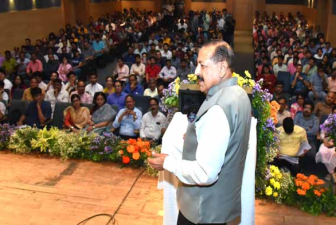
Union Minister Dr. Jitendra Singh participated in the 150-year celebrations of the Indian Association for the Cultivation of Science (IACS) in Kolkata. Established in 1876, IACS is India’s oldest research institute and the historic site where Sir C.V. Raman discovered the Raman Effect, which secured India’s first Nobel Prize in Science. During the commemorative event, the minister inaugurated an indigenously developed Plasma Enhanced Chemical Vapor Deposition (PECVD) system for amorphous silicon solar cells along with a new research entrepreneurship incubation center named RETINA, aligning with the vision of self-reliance and Viksit Bharat 2047.
Historical Significance of IACS
The Indian Association for the Cultivation of Science represents the foundation of modern scientific research in India.
Foundation and Vision
- Establishment: Dr. Mahendralal Sircar, a medical practitioner and social reformer, founded IACS in 1876 in Kolkata.
- Objective: The institute aimed to provide Indian scientists with a dedicated space to conduct independent, cutting-edge scientific research during the colonial era.
- National Awakening: It served as a prominent symbol of India’s intellectual self-reliance and scientific awakening.
Scientific Pioneers Associate with IACS
- Sir C.V. Raman: Conducted his groundbreaking research on light scattering at IACS laboratories between 1907 and 1933.
- Acharya Jagadish Chandra Bose: Conducted early investigations into plant physiology and radio waves.
- Meghnad Saha: Contributed fundamentally to astrophysics through his thermal ionization equation, which helps determine stellar atmospheres.
- Satyendra Nath Bose: Developed the Bose-Einstein statistics, laying the groundwork for quantum mechanics.
Understanding the Raman Effect
The discovery of the Raman Effect on February 28, 1928, revolutionized the study of light and matter interaction.
Scientific Mechanism
- Inelastic Scattering: When light encounters a molecule, most photons scatter elastically (Rayleigh scattering) with no change in energy or wavelength. However, approximately one in ten million photons scatters inelastically.
- Energy Shift: This inelastic collision results in a shift in the photon’s energy, wavelength, and frequency. The shift depends entirely on the vibrational and rotational energy levels of the scattering molecule.
- Molecular Fingerprint: The unique pattern of shifted frequencies creates a distinct spectrum for every substance, allowing precise identification of chemical structures.
Applications of Raman Spectroscopy
- Material Science: Analyzing the structural properties of graphene, carbon nanotubes, and semiconductors.
- Pharmaceuticals: Identifying polymorphs, monitoring drug purity, and detecting counterfeit medications without destroying samples.
- Defense and Security: Real-time, non-contact detection of explosives, narcotics, and hazardous chemical agents at transit points.
- Medicine and Diagnostics: Identifying cancerous tissues and analyzing biomolecules in blood or tissue samples.
Infrastructure and Entrepreneurship Upgrades
The sesquicentennial celebration marked the deployment of advanced indigenous technology and innovation frameworks at the institute.
Plasma Enhanced Chemical Vapor Deposition (PECVD)
- Technology: An indigenously developed system that uses thin-film deposition techniques to coat substrates with solid materials from a chemical vapor state using plasma.
- Application: Specifically engineered to fabricate high-efficiency amorphous silicon solar cells.
- Impact: Reduces import dependency for solar component manufacturing and supports India’s renewable energy goals.
RETINA Incubation Center
- Name: Research Entrepreneurship for Technology Innovation and Academic Advancement.
- Function: Provides lab-to-market support, physical infrastructure, mentoring, and seed funding for deep-tech startups.
- Focus Area: Translating laboratory discoveries in materials science, quantum computing, and biotechnology into commercial products.
IASPOINT Booster Facts for UPSC
- National Science Day: India celebrates National Science Day every year on February 28 to commemorate the discovery of the Raman Effect in 1928.
- Nobel Prize Timeline: Sir C.V. Raman received the Nobel Prize in Physics in 1930, becoming the first Asian to win a Nobel Prize in any scientific discipline.
- First President of IACS: Sir Richard Temple, the then Lieutenant Governor of Bengal, served as the statutory president during its inception, while Dr. Mahendralal Sircar was the primary architect.
- Autonomous Status: IACS operates today as an autonomous institution funded by the Department of Science and Technology (DST), Government of India, and holds the status of a Deemed to be University.
- Bharat Ratna: Sir C.V. Raman received India’s highest civilian award, the Bharat Ratna, in 1954 in its inaugural year of institution.