
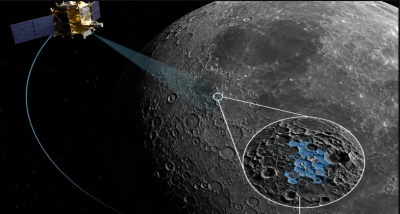
Recently, scientists from the Physical Research Laboratory in Ahmedabad analyzed data from India’s Chandrayaan-2 lunar orbiter and found compelling evidence of subsurface water ice near the Moon’s South Pole. The discovery relies on observations from the orbiter’s Dual Frequency Synthetic Aperture Radar, which probed beneath the lunar surface to map permanently shadowed regions. The findings confirm the presence of buried ice within extreme cold traps, specifically doubly shadowed craters. This breakthrough strengthens the prospects for future human settlements by providing a local source of water, oxygen, and rocket propellant for deep-space exploration.
Dual Frequency Synthetic Aperture Radar Analysis
- The Dual Frequency Synthetic Aperture Radar is a microwave imaging instrument operating on the active Chandrayaan-2 lunar orbiter.
- It holds the distinction of being the first fully polarimetric synthetic aperture radar deployed to study the lunar surface.
- The instrument transmits structured L-band and S-band microwave radio frequencies that penetrate the top-layer lunar dust to interact with hidden subsurface materials.
- Researchers developed a refined radar-based criterion to distinguish genuine ice-related radar signals from reflections caused by rough rocky terrain.
- The analysis identified subsurface ice by filtering for regions where a high Circular Polarization Ratio corresponds with an ultra-low Degree of Polarization, indicating volumetric scattering typical of buried ice.
Target Locations and Doubly Shadowed Craters
- The research focused on doubly shadowed craters situated inside the permanently shadowed regions of the lunar South Pole.
- These specific crater interiors never receive direct sunlight or thermal radiation from the surrounding landscape.
- Temperatures in these extreme cold traps remain pinned around 25 Kelvin (approximately -248 degrees Celsius), acting as deep freezers capable of preserving water ice over billions of years.
- The radar mapping successfully confirmed the potential presence of buried water ice beneath the floors of four distinct doubly shadowed craters.
The Faustini Crater Anomaly
- The strongest candidate identified in the study is a small micro-crater measuring 1.1 kilometers in diameter, nestled entirely inside the larger Faustini crater.
- This specific crater exhibits a highly unusual flow-like structure known as lobate-rim morphology.
- Geological models suggest that the initial meteoroid impact penetrated an ice-rich subsurface layer.
- The impact briefly melted the buried ice to create a fluid ejecta pattern that sloshed outward and re-froze into a unique lobed shape along the crater rim.
Implications for In-Situ Resource Utilization
- Transporting heavy supplies like water from Earth is extremely expensive and limits mission payload capacities.
- Subsurface lunar ice is critical for In-Situ Resource Utilization, allowing future crewed bases to harvest local materials for survival.
- Mined and purified ice can supply drinking water and breathable oxygen for astronauts stationed at lunar habitats.
- Through electrolysis, the water can be split into liquid hydrogen and oxygen to manufacture rocket fuel directly on the Moon.
- Establishing a local propellant source transforms the Moon into a strategic refueling station for upcoming missions to Mars and beyond.
IASPOINT Booster Facts for UPSC
- Physical Research Laboratory: Founded in 1947 by Dr. Vikram Sarabhai in Ahmedabad, it operates as an autonomous unit under the Department of Space, conducting basic research in space and allied sciences.
- Chandrayaan-2 Orbiter: Launched in July 2019, the orbiter continues to circle the Moon and relay high-resolution scientific data, despite the failure of its Vikram lander to achieve a soft touchdown.
- Volumetric Scattering: A phenomenon where radar waves penetrate a surface and bounce around internally within pocketed materials like ice before reflecting back, altering the wave properties.
- Degree of Polarization: A radar parameter measuring how much of the reflected signal retains its original polarization state after interacting with surface or subsurface materials.
- Lunar Regolith: The layer of unconsolidated solid material covering the bedrock of the Moon, consisting of dust, soil, and broken rock.
- Artemis Program: A United States-led international human spaceflight program aiming to establish a sustainable presence on the Moon, heavily targeting the water-rich lunar South Pole.