
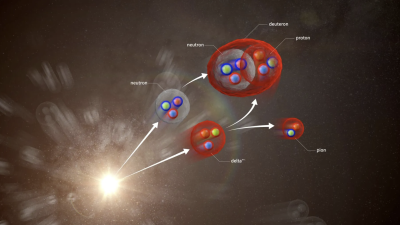
The ALICE collaboration at CERN’s Large Hadron Collider has clarified how deuterons, the nuclei of deuterium, survive in high-energy proton collisions. Although deuterons are weakly bound and should be fragile in such violent conditions, experiments show that they are still produced. The new finding indicates that most deuterons are not created directly at the moment of collision. Instead, they form later through coalescence, when a proton and a neutron combine after a short-lived resonance decays.
What Is a Deuteron?
A deuteron is the nucleus of deuterium, an isotope of hydrogen. It contains one proton and one neutron. Its binding energy is low, which makes it comparatively easy to break apart. This has long raised a question in particle physics – how can such a delicate nucleus appear in the extreme environment created at the LHC?
Two Formation Mechanisms
Physicists considered two main explanations:
- Direct emission: deuterons are produced directly from the collision zone.
- Coalescence: a proton and neutron are produced first and later bind together if conditions allow.
The coalescence model requires a third particle, usually a pion, to carry away excess energy. This makes the process possible without the pion becoming part of the final deuteron.
How ALICE Studied the Process
The team used femtoscopy, a technique that examines whether two particles emerge with similar velocities more often than random chance would suggest. They focused on pion-deuteron correlations and searched for the signature of the Δ(1232) resonance, a short-lived excited state that decays into a pion and a proton or neutron. The data showed a positive correlation, indicating that deuterons often form after the Δ resonance decays.
Why the Finding Matters
The study suggests that about 62% of deuterons are produced after Δ decays, and nearly 80% may form through coalescence when other short-lived resonances are included. This helps explain why deuterons can appear in LHC collisions. It also improves models of light nuclei and antinuclei production in cosmic rays, interstellar matter, and possible dark matter-related processes.
Last Modified: April 27, 2026