
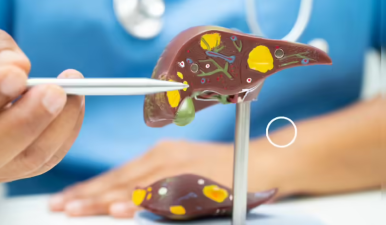
A study from the Sanjay Gandhi Postgraduate Institute of Medical Sciences (SGPGIMS), published in May 2026, reveals that fatty liver disease impairs the organ’s ability to activate vitamin D. The disease reduces the production of the enzyme CYP2R1, which converts vitamin D into its usable form, 25-hydroxyvitamin D. Researchers observed this enzyme reduction in human liver samples and animal models fed high-fat and high-sugar diets. This finding explains why patients with severe fatty liver disease often exhibit severe vitamin D deficiency despite having adequate sunlight exposure and dietary intake.
Mechanics of Vitamin D Activation
The liver plays a vital role in processing vitamin D before the body can utilize it for bone health and immune function.
The Hydroxylation Process
Vitamin D obtained from sunlight (cholecalciferol) or dietary sources is biologically inactive. It must undergo two metabolic steps, called hydroxylations, to become active:
- First Hydroxylation: This occurs in the liver. The enzyme CYP2R1 converts vitamin D into 25-hydroxyvitamin D, also known as calcidiol. This is the primary circulating form of the vitamin measured in blood tests.
- Second Hydroxylation: This occurs mainly in the kidneys. The enzyme CYP27B1 converts calcidiol into 1,25-dihydroxyvitamin D, or calcitriol, which is the fully active hormone.
Impact of Fatty Liver on CYP2R1
Fatty liver disease causes lipid accumulation inside liver cells, triggering inflammation and cellular stress. This metabolic dysfunction suppresses the expression of the CYP2R1 gene. As a result, the liver produces fewer CYP2R1 enzymes, breaking the metabolic chain and preventing the conversion of raw vitamin D into calcidiol.
Progression of Fatty Liver Disease
Fatty liver disease develops along a spectrum of severity, moving from simple fat accumulation to permanent organ damage.
Metabolic Dysfunction-Associated Steatotic Liver Disease (MASLD)
Previously known as Non-Alcoholic Fatty Liver Disease (NAFLD), this initial stage involves simple steatosis, where fat builds up in more than 5% of liver cells without causing major inflammation.
Metabolic Dysfunction-Associated Steatohepatitis (MASH)
Previously called NASH, this is the severe form of fatty liver disease highlighted in the study. Fat accumulation is accompanied by liver cell injury, ballooning, and chronic inflammation.
Advanced Complications
If MASH is left unchecked, the continuous inflammation triggers the following conditions:
- Fibrosis: The buildup of scar tissue in the liver.
- Cirrhosis: Extensive scarring that permanently disrupts liver architecture and blood flow.
- Liver Failure: The complete inability of the liver to perform synthetic and metabolic functions.
- Hepatocellular Carcinoma: A primary type of liver cancer driven by chronic inflammation and tissue regeneration.
Consequences of the Liver-Vitamin D Deficiency Link
The reduction of CYP2R1 creates a systemic health deficit because vitamin D regulates multiple physiological pathways.
| Affected System | Role of Vitamin D | Impact of Liver-Induced Deficiency |
| Skeletal System | Promotes calcium and phosphorus absorption | Bone thinning, osteomalacia, and increased fracture risks |
| Immune System | Modulates T-cell and macrophage responses | Increased susceptibility to infections and chronic inflammation |
| Metabolic System | Enhances insulin sensitivity in peripheral tissues | Worsened insulin resistance, accelerating diabetes and obesity |
| Cardiovascular System | Regulates blood pressure and endothelial function | Increased risk of hypertension and arterial stiffness |
Public Health Recommendations and Interventions
The discovery that fatty liver disease causes vitamin D deficiency, rather than just coexisting with it, changes clinical management strategies.
Dietary and Lifestyle Modifications
Treating the root liver condition is necessary to restore vitamin D metabolism. Interventions include reducing the intake of ultra-processed foods, high-fructose corn syrup, and saturated fats. Regular physical activity helps clear intrahepatic triglycerides, relieving cellular stress on the CYP2R1 enzyme.
Clinical Supplementation Strategies
Standard oral vitamin D3 supplements may be ineffective for MASH patients because their livers cannot process them. Clinicians may need to bypass the liver checkpoint by administering calcidiol (25-hydroxyvitamin D) directly to correct deficiencies in individuals with advanced liver disease.
IASPOINT Booster Facts for UPSC
- CYP2R1 Enzyme: This enzyme belongs to the Cytochrome P450 superfamily of enzymes. These proteins use heme as a cofactor to oxidize a vast range of compounds.
- Fatty Liver Disease Nomenclature: Global medical societies updated the terminology from NAFLD/NASH to MASLD/MASH to remove stigmatizing language (“non-alcoholic”) and focus on metabolic risk factors like obesity and diabetes.
- Fat-Soluble Vitamins: Vitamin D is one of the four fat-soluble vitamins, alongside Vitamins A, E, and K. These vitamins are stored in the liver and fatty tissues.
- Dual Nature of Vitamin D: Vitamin D acts both as a nutrient obtained from food and as a prohormone synthesized by the skin through exposure to Ultraviolet B (UVB) radiation.
- Epithelial Cells and Calcitriol: Calcitriol binds to Vitamin D Receptors (VDR) in the intestines to stimulate the synthesis of calcium-binding proteins, ensuring efficient dietary calcium absorption.