
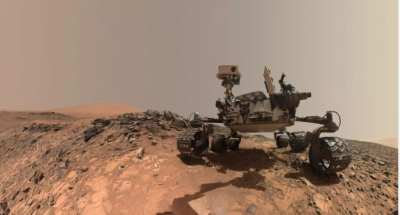
NASA’s Curiosity Mars rover detected 21 carbon-containing molecules in a rock sample drilled in 2020 from Gale Crater on Mars. The sample, named Mary Anning 3, came from a clay-rich area of Mount Sharp, a central mound inside Gale Crater that contains ancient sedimentary rocks.
Curiosity Rover and Gale Crater
Curiosity is a NASA Mars Science Laboratory rover that landed in Gale Crater in 2012. Gale Crater is about 154 kilometres wide and contains Mount Sharp, also called Aeolis Mons. The crater has been studied for evidence of ancient lakes, streams, and habitable environments.
Organic Molecules on Mars
Organic molecules are carbon-based compounds that can contain hydrogen, oxygen, nitrogen, sulphur, or phosphorus. The newly identified set includes seven molecules recorded for the first time on Mars. One of them is a nitrogen heterocycle, which is a ring-shaped compound containing nitrogen atoms. Nitrogen heterocycles are part of the chemical structures of RNA and DNA on Earth.
Sample Analysis at Mars
The findings were obtained with the Sample Analysis at Mars, or SAM, instrument inside Curiosity. SAM is a mini laboratory that includes a mass spectrometer, a gas chromatograph, and a tunable laser spectrometer. It is designed to analyse gases and volatile compounds released from heated Martian samples.
Prebiotic Chemistry and Benzothiophene
Benzothiophene is a carbon- and sulphur-bearing molecule identified in the sample. Benzothiophene has also been found in meteorites, and meteorites are natural objects that survive passage through Earth’s atmosphere. The presence of sulphur-bearing organics is relevant to prebiotic chemistry, which is the study of chemical processes that preceded life on Earth.
Martian Preservation Conditions
Mars has a thin atmosphere, low surface pressure, and high ultraviolet radiation at the surface. These conditions affect organic preservation, while burial in rocks can protect compounds for long periods. Clay minerals are known on Earth to bind and preserve organic matter in sedimentary environments.
Lead Research Context
Amy Williams of the University of Florida was the lead author of the study published in Nature Communications on 21 April 2026. The study recorded the first confirmed nitrogen heterocycles on the Martian surface and in Martian meteorites.
Last Modified: April 24, 2026