
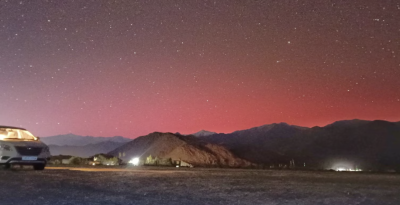
A rare blood-red aurora lit up the night sky over Hanle Dark Sky Reserve in eastern Ladakh on January 19 and 20. The display was captured by the all-sky camera at the Indian Astronomical Observatory and became visible on clear, moonless nights over the high-altitude plateau. Such auroral activity is unusual at this low latitude and is generally seen closer to polar regions.
Aurora Over Hanle
The glow was strongest towards the northern horizon and was visible from around 9:30 pm until midnight. Hanle, near the Indian Astronomical Observatory, is one of India’s best locations for dark-sky viewing. Nearby areas such as Merak village near Pangong Tso also offer favourable conditions for skywatching when the atmosphere is clear.
Cause of the Geomagnetic Storm
The aurora was linked to a strong geomagnetic storm triggered by solar activity. An X-class solar flare on January 18 released a coronal mass ejection, a large cloud of charged plasma and magnetic fields. The CME travelled towards Earth at very high speed and interacted with the planet’s magnetic field, causing a G4-level geomagnetic storm. The storm reached peak disturbance at around 8:30 pm on January 20.
Why the Aurora Was Red
The red colour appeared when high-altitude oxygen atoms, more than 300 kilometres above Earth, were excited by incoming solar particles. This produced a distinct red glow rather than the more common green aurora seen at lower altitudes. The event was among the few intense geomagnetic storms recorded during the current solar cycle.
Space Weather Significance
Scientists are studying such events to understand the Sun’s impact on Earth’s space environment. Strong geomagnetic storms can affect satellites, radio communication, navigation systems, and power grids. The Hanle display brought into light both the scientific importance of auroras and the risks posed by extreme solar activity.
Last Modified: April 27, 2026