
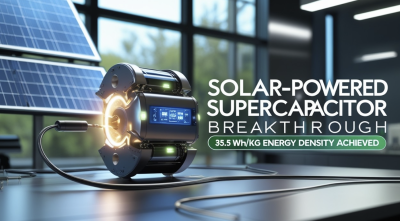
Indian scientists under the Department of Science and Technology have developed a solar-powered energy storage device that can both capture and store energy in a single unit. The innovation is a photo-rechargeable supercapacitor, designed to reduce conversion losses, lower system cost, and support clean, self-sustaining power solutions for portable, wearable and off-grid applications.
What the device does
The new system combines solar energy harvesting and electrical storage in one compact device. Conventional solar setups usually need separate units for power generation and storage, along with extra electronics to manage voltage and current mismatches. This new design removes that complexity and reduces the device footprint.
Scientific design and material use
The device was developed at the Centre for Nano and Soft Matter Sciences, Bengaluru, under DST. It uses binder-free nickel-cobalt oxide (NiCo2O4) nanowires grown on nickel foam through a simple in situ hydrothermal process. The nanowires are only a few nanometres wide and several micrometres long. They form a porous, conductive three-dimensional network that can absorb sunlight and store charge efficiently.
Performance and practical relevance
In testing, the device delivered a stable output voltage of 1.2 volts. It retained 88 per cent capacitance after 1,000 photo-charging cycles. It also worked under a wide range of light conditions, from low indoor illumination to intense sunlight. This indicates durability under mechanical and electrochemical stress.
Potential applications
The technology may support self-charging power systems in remote regions without grid access. It can reduce dependence on fossil fuels and conventional batteries. Its low-cost and eco-friendly nature makes it relevant for autonomous devices, miniaturised electronics and off-grid energy needs.
Last Modified: April 27, 2026