
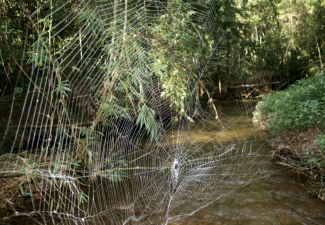
Darwin’s bark spider silk has drawn scientific attention for its exceptional strength and toughness. A recent study on Madagascar’s orb-weaving spiders shows that this remarkable silk is not produced uniformly by all individuals. Instead, the highest-performance silk is linked to large adult females, their web-building needs, and the ecological demands of capturing prey over rivers and lakes.
Key Finding
The study found that only large adult female Darwin’s bark spiders produce exceptionally tough dragline silk. Male spiders and juveniles, regardless of sex, produced silk that was mechanically similar and far less tough. This suggests that extreme silk performance is an adaptive trait linked to body size and reproductive role.
What Makes the Silk Special
- Darwin’s bark spider silk has a tensile strength of about 1.6 gigapascals.
- It is among the toughest biological materials ever tested.
- The silk is rich in proline, which helps increase elasticity but raises metabolic cost.
- Stretchability remained high across all individuals, indicating a conserved trait.
Web Design and Ecology
Adult females build very large orb webs, sometimes up to 25 metres wide, across rivers and lakes in Madagascar. These webs are sparse but highly efficient, using less silk per unit area while relying on stronger threads. Juveniles and males build denser webs with weaker, cheaper silk. The findings show that silk quality is closely tied to web architecture and ecological function.
Scientific Significance
The study marks how evolution balances energy cost and survival advantage. Producing tougher silk requires more time and energy, so the spider appears to activate this ability only when needed. It also shows that silk properties depend on protein composition, cross-linking, and the structure of spinning ducts inside the spider’s body.
Last Modified: April 27, 2026